Showing posts with label Religion. Show all posts

Monday, May 15, 2023

Coronation of King Charles III

While I'm obviously no longer the frequent blogger I used to be, since I don't want this blog to be considered completely defunct, I can hardly ignore here the glorious historic Coronation of last Saturday 6 May (covered extensively on my social media), in which Charles III was crowned King of the United Kingdom in Westminster Abbey. I was of course up at 4:15 AM Dallas time to watch the event live on YouTube, following along in my printout of the liturgy, and with millions around the world was thrilled by the spectacle, the spiritual power of the occasion, and the music. As a Loyalist I joined enthusiastically in the Homage of the People. God Save the King!

I assume that readers (if I still have any) have by now seen plenty of Coronation coverage elsewhere, so I will not attempt to be comprehensive in this rather belated post. Instead, I wish to share some links to photo galleries, videos, and thoughtful articles (more or less in reverse chronological order of appearance, as is fitting for the blog format) that you might not have seen, as well as the official photographs taken in Buckingham Palace after the event.

Alexandra Wilson, Music fit for a king

Charles A. Coulombe, After the Crowning

Fr. Steve Rice, God Bless America, God Save the King

Zewditu Gebreyohanes, Britain is Lucky to Have a Monarch (Telegraph)

Benjamin Guyer, Charles III and Kenotic Monarchy
Ruth Dudley Edwards, Coronation of King Charles is a reminder...

John Martin Robinson, Coronation Diary

YouTube: The Coronation Weekend (Prince & Princess of Wales)

Saint Thomas Church: A Service of Thanksgiving for the Coronation of HM King Charles III

CNN: In pictures: the coronation of King Charles III
BBC: Extraordinary photos from King Charles III's Coronation

Mail on Sunday: If we heeded republican wails...

Daily Mail: The new Firm assembles

Paul Shakeshaft, Why a Coronation Matters

Sohrab Ahmani, Coronation is a ritual humiliation

Esmé Partridge, In Defense of the Philosopher King

Rebecca Mead, The Self-Justifying Philosophy of King Charles

Tom Holland, Our bronze age coronation rites seem to speak to a modern love of the sacred

Aris Roussinos, Britain Needs King Charles the Weird

The Critic: Crowning Moment

Anna Tyzack, What sort of man is King Charles, and what sort of king will he be? (2022)


Monday, March 13, 2023

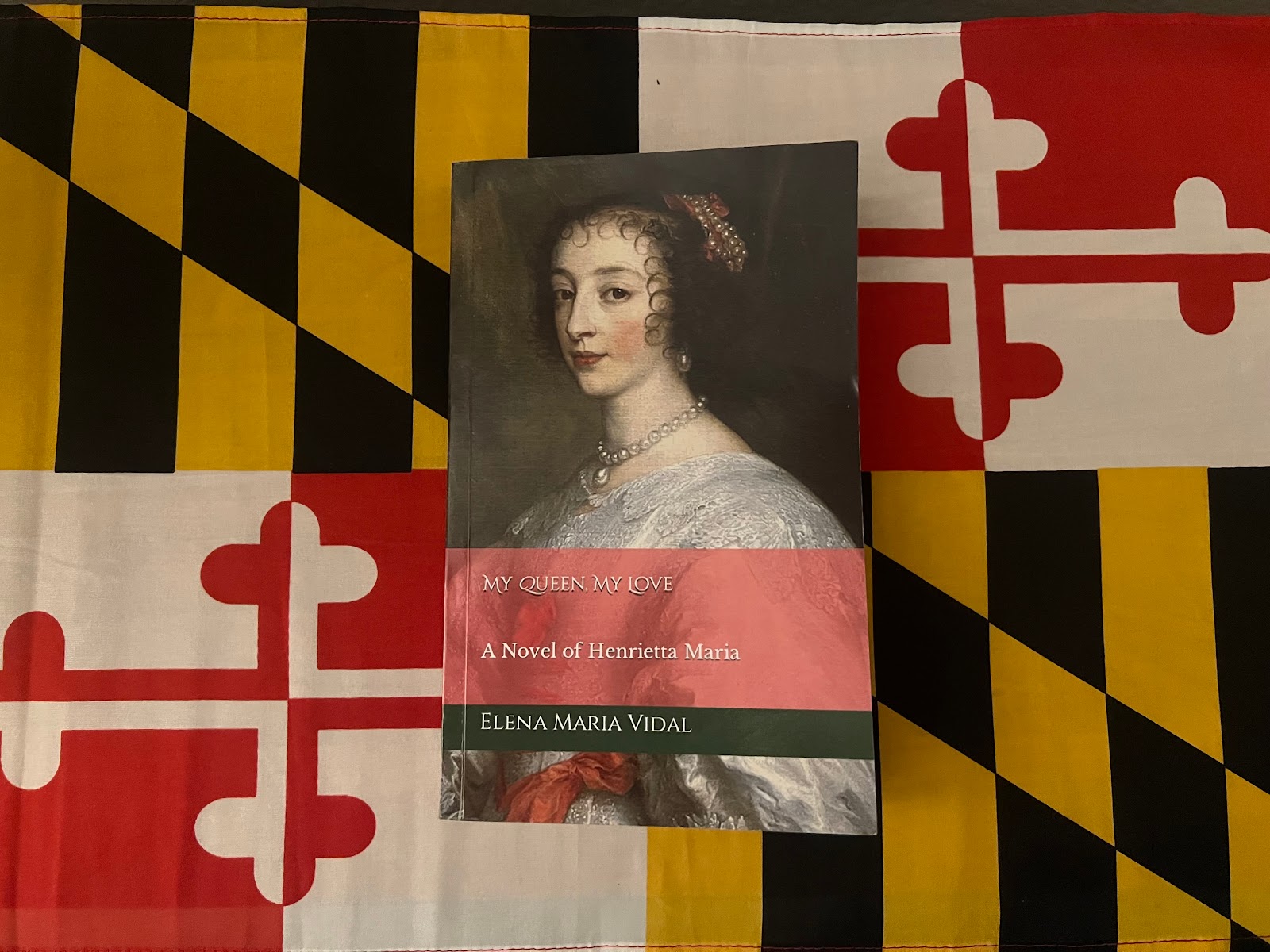
Review: Elena Maria Vidal's "My Queen, My Love"


Most Americans are probably not aware that the US state of Maryland was originally named after Queen Henrietta Maria (1609-1669), daughter of King Henri IV of France (1553-1610) and wife of the ill-fated King Charles I of England (1600-1649). Readers seeking an introduction to this unjustly neglected historical figure would do well to immerse themselves in this charming and engaging book by Elena Maria Vidal, who appropriately enough lives in Maryland.

"My Queen, My Love," which covers the title character's life from her childhood in France through the births of her own children in the 1630s on the eve of the English Civil War, is a historical novel, so includes fictionalized dialogue, but is firmly based on historical research like any biography. Its style vividly brings the complex and colourful world of the 17th century to life, from Italy [homeland of her mother Marie de Medici (1573-1642)] to France to England. The central importance of religion is evident from the outset. Daughter of the pragmatic convert Henri IV, the devoutly Catholic Henrietta Maria finds herself in an impossible situation as wife of the staunch Anglican Charles I in what is by then a predominantly and fervently Protestant country, with even the King's own high church Anglicanism increasingly deemed too "catholic" by some. While the author clearly shares Henrietta Maria's devout Roman Catholicism, it is to Vidal's credit that the sincerity of King Charles who believes that his Church of England is truly Catholic is depicted in a well-rounded manner. I particularly appreciated the writer's evident love of liturgical beauty as reflected in lavish descriptions of Catholic ceremonies including sacred music. Henrietta Maria's enjoyment of the secular arts, so scandalous to the dour Puritans especially her own participation in Masques, is a consistent theme as well.

Anglicans like me who revere Charles as a Martyr, aware of his and his wife's fervent loyalty to each other during the terrible trials of the Civil War which (after the time period covered by this book) would end in his execution and her widowhood, are accustomed to thinking of their marriage as an ideal devoted Christian one, as indeed it later became. However it must be admitted that this was not always the case. While vaguely aware that King Charles and Queen Henrietta Maria had had difficulties in the early years of their marriage, I had not thought much about the details until I read this book. One sensitive issue is that in order to gain French approval for their 1625 marriage Charles had had to make various promises, particularly those related to the Queen's Catholicism, that once back in England he finds himself unable to keep. It particularly galls her, understandably, that money from her dowry ended up being used to fund a war with her native France! While Vidal's Henrietta Maria never falters in her ultimately heroic love for Charles, the reader can also see without dismissing his point of view how Charles might have felt frustrated at times.

To the extent that the narrative of the challenging early years of their marriage has a villain, it is surely George Villiers, Duke of Buckingham (1592-1628). A favourite of Charles's father James I (1566-1625), Buckingham continues his leading role in British affairs as a sort of substitute older brother (Charles's real older brother Henry having sadly died at 18 in 1612) of the young and insecure new king. Wary of losing his pre-eminence should the Queen replace him as the King's most trusted confidant, Buckingham (though capable of great charm) does everything he can to undermine the Queen's position and behaves with shocking disrespect to her, while also being egotistically heedless of his unpopularity among the common people who tend to blame him rather than the King for the failures of his aggressive foreign policy. Charles either cannot or will not see this other side of him, and when Buckingham meets his end the reader is likely to feel that he had it coming. Whether the final chapter's theory about who was ultimately behind the assassination is true, I cannot say, but there is no doubt that Buckingham's death finally smoothes the path for Charles and Henrietta Maria to eventually enjoy a happier marriage.

Whether new to the period or an experienced student of Stuart history, any reader will be sure to finish this delightful book knowing Queen Henrietta Maria better than before, almost like a personal friend. I highly recommend it to anyone interested in royal history and look forward to further installments as given her tumultuous life there is certainly more material to come.


Saturday, December 31, 2022

RIP Benedict XVI (1927-2022)

His Holiness Benedict XVI (née Joseph Ratzinger), who reigned as Pope of the Roman Catholic Church and Sovereign of the State of Vatican City from 2005 to 2013, has died at 95, nearly four months after Queen Elizabeth II.

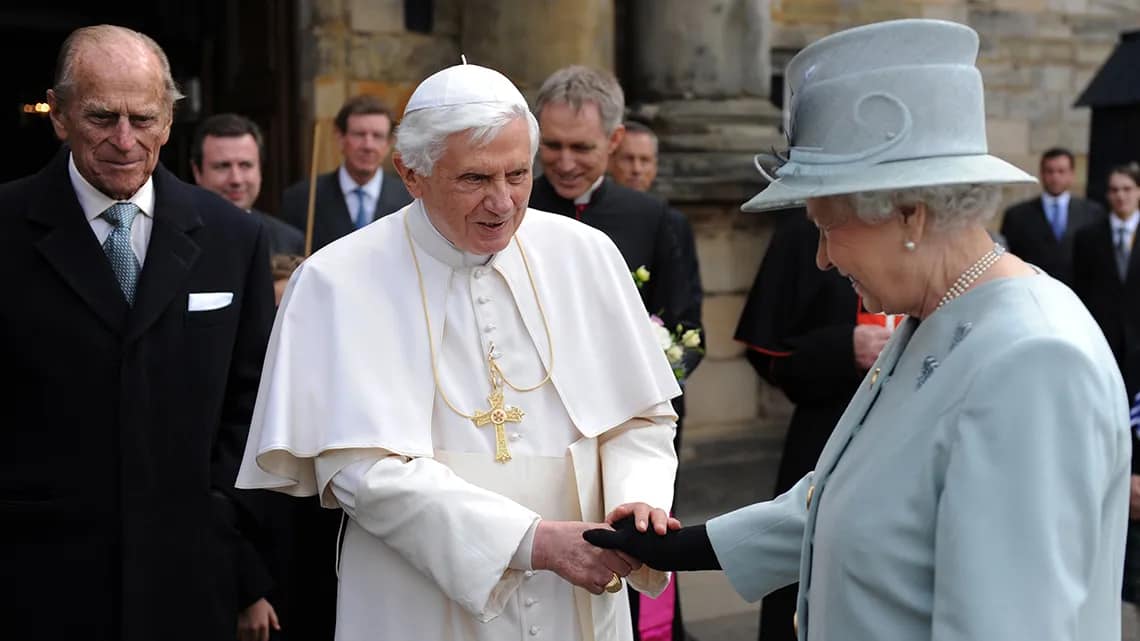
I particularly appreciated his love of classical music and concern for liturgical Beauty, without which in general I confess that it’s unlikely Christianity ever would have appealed to me. He cared, and understood. Aesthetics Matter. A highlight of his pontificate was his September 2010 visit to the United Kingdom. His delight at the Anglican choral tradition at Westminster Abbey was evident, and his pontifical mass at Westminster Cathedral was a musical feast of Byrd and Bruckner. 🇬🇧

Many commentaries will probably not mention that as a young man in 1951 he was ordained to the priesthood by Cardinal Michael von Faulhaber (1869-1952), a Bavarian monarchist who had also conducted the funeral of King Ludwig III (1845-1921) thirty years earlier and never abandoned his belief in the Monarchy. As the former Fr. Ratzinger was the last living priest ordained by Cardinal von Faulhaber, his death breaks a last living link with the Kingdom of Bavaria.

The undoing of his greatest accomplishment, the 2007 liberalisation of the Latin Mass, by his successor is a terrible tragedy.

I wish he hadn’t abdicated. But perhaps that’s not for us in this world to ever understand. May he rest in peace.


Friday, September 16, 2022

Our Gloriana

Here is an eloquent reflection on the death of Queen Elizabeth II, "Our Gloriana," by Bishop Anthony Burton (Rector of Church of the Incarnation 2008-22, who baptized me there in 2009).


[Edit: and here is one from a Catholic friend at Georgetown University: The Queen's Jesuit Values.]

Thursday, September 15, 2022

Dallas Episcopalians remember the Queen

The Dallas Morning News reports on Tuesday's Choral Evensong in thanksgiving for Queen Elizabeth II at St. Matthew's Cathedral, in which I sang (music of Vaughan Williams, Stanford, and Parry). I am quoted in the article. Needless to say I don't endorse every comment of the homilist. But it was a lovely event and I'm glad it's been publicized.


Wednesday, September 14, 2022

On Mourning the Queen as an American Monarchist

Probably my greatest weakness as a Christian is that while this should not be construed as ingratitude for the positive aspects of my real life I’ve never been able to overcome a certain theoretical resentment at having been born American rather than British, which prevents me from ever feeling quite as docile to God’s will as we’re apparently supposed to, as indeed the late Queen herself was. Indeed, my whole way of being Christian as an Episcopalian is so deeply intertwined with Anglophilia and the Monarchy (which for an Anglican in England would be nothing abnormal) that I don’t know how to separate the two. It’s all sort of the same thing for me, which I suppose is why I tend to see “British” republicans as utterly evil enemies of God, akin to the monstrous orcs in Lord of the Rings, rather than as simply people I disagree with.

As lovely as last night’s Evensong [in thanksgiving for the life of Queen Elizabeth II at St. Matthew's Cathedral] mostly was, there were still a few lines in the homily that made me wince, as did the fact that even on this most inherently royalist of occasions the officiant still sang “State” rather than “King” during the (Smith) Responses. Even many Americans sincerely paying tribute to the Queen feel obliged to include some sort of republican disclaimer, which I never like, because I wholeheartedly believe that “our” way is wrong and theirs is right. I suppose a certain such discomfort is inevitable as long as I live here, and I don’t seem to be moving. But with all my heart I reject 1776 and all its works. God Save the King.


Friday, April 1, 2022

Remembering Bl Karl

Today I attended a mass in honour of the centennial of the death of Emperor Bl. Karl (1887-1922) at St. Philip the Apostle Catholic Church in Flower Mound, Texas. The brand new church is one of the most attractive new churches I've seen, with expansion of the sanctuary and a new Casavant pipe organ yet to come. The celebrant was Fr. Allan Hawkins, originally from England, who had corresponded with Bl. Karl's son & heir Archduke Otto (1912-2011) for decades. It was Fr. Hawkins who in 2010 invited me to give a talk on sacred music at St. Mary the Virgin Catholic Church in Arlington, of which he was then the pastor. Not having expected until he invited me to be able to attend any events commemorating this centennial, I was very glad to be able to attend this mass, which concluded with appropriate English words to Haydn's immortal Kaiserhymne, the Habsburg imperial anthem.

Blessed Karl, pray for us!


Centennial of the Death of Bl Karl

One hundred years ago today, the holy Emperor Karl I of Austria-Hungary (1887-1922), died at only 34 in exile in Madeira. A true royal saint of modern times, he had done his best in his brief reign (1916-18) with the challenging situation he inherited and did everything he could to end the horrors of the Great War and serve his people, but treacherous and ignorant men thwarted and betrayed him. Emperor Bl. Karl, pray for us and for the restoration of the Habsburg Monarchy!


Sunday, March 27, 2022

Haydn quartet online

I rarely use this blog to promote my own performances as a cellist. However, since I'm currently taking a break from Facebook and feel the need to post about this somewhere, I'll make an exception today. Tonight with three of my Dallas Symphony colleagues I will be performing Haydn's monumental string quartet "The Seven Last Words of Christ" at Birchman Baptist Church in Fort Worth, a project of Crescendo. A short Instagram preview from last Friday's dress rehearsal for the first concert at my own church is available here. I mention it here regardless of whether any readers can attend in person, because the performance is available to watch and listen online on Facebook. Please tune in!


Sunday, March 13, 2022

Grand Duchess Elizabeth at Saint Thomas Church

I've been listening to the webcasts of New York's Saint Thomas Church for over 15 years, attending in person as often as possible between 2007 and 2019. I am pleased that today's Solemn Evensong, which you can watch and hear online, features a sermon on Grand Duchess St. Elizabeth of Russia (1864-1918), one of Westminster Abbey's ten Modern Martyrs, by Mo. Susan Hill of NYC's Church of the Holy Apostles. This sermon is part of Saint Thomas's Lenten series, "'A Grain of Wheat': Martyrs of Our Time." Mo. Hill skillfully links Elizabeth's holy life to the needs of our contemporary world.

Daughter of Grand Duke Louis IV of Hesse (1837-1892) and Queen Victoria's daughter Princess Alice of the United Kingdom (1843-1878), Elizabeth was considered one of the most beautiful princesses of her generation. In 1884, having rejected other suitors including the future Kaiser Wilhelm II, she married Grand Duke Sergei of Russia (1857-1905), at which occasion her younger sister Princess Alix (1872-1918) first met her future husband, Sergei's nephew who later became Tsar Nicholas II (1868-1918). Not required by Russian law to convert to Orthodoxy since her husband was not in direct line to the throne, she nevertheless did so voluntarily several years later. After her husband's assassination in 1905, she renounced her glittering royal lifestyle for one of heroic service to the poor of Moscow as a nun. She had little political influence on her sister or on subsequent events in Russia, but the Revolution showed her no mercy. In July 1918, the day after the more famous Ekaterinburg murders, she and her companion Sister Barbara and several other members of the imperial family (including Grand Duke Sergei Mikhailovich, a brother of the subject of my previous post) were murdered by the Bolsheviks in Alapayevsk, a location (now a monastery) which I visited in 2018 several days before the centennial. She was canonized in 1981 by the Russian Orthodox Church Abroad and in 1992 by the Moscow Patriarchate. 

I have no doubt that current events in her adopted homeland would grieve her deeply, but she would do what she always did and try to help those in need as much as she could.


Sunday, July 18, 2021

Latin Mass

Below are some assorted thoughts on Friday's Vatican decree, originally intended for Facebook. (16 July) This isn’t really my fight anymore. But if I were Catholic I’d be angry and defiant. I will always promote and defend the incomparable treasury of music, art, and architecture inspired by the Latin Mass.

(18 July) It was striking that at Incarnation this morning, two days after a certain cruel and malicious document emanated from the regime in Rome, that both choral works (Byrd Ego sum panis vitae & Gabrieli O sacrum convivium) were in Latin, written for the Roman Catholic Church when it was a serious institution with serious liturgy and music. I am so grateful to be an Episcopalian.

Eighty-five years ago yesterday, which happened to be the 18th anniversary of the murder of the Romanovs (a fact that I'm sure must have been noted by some at the time), after five years of republican chaos, right-wingers in Spain decided they'd had enough. "Traditionis Custodes" deserves no more respect or obedience than the Spanish Republic did. Before I make a point implicitly critical of some American traditionalists, let me be clear that there is absolutely no justification whatsoever for what the Vatican regime promulgated on Friday. I think it is one of the most evil papal (?) pronouncements in the entire history of the Roman Catholic Church. Many good Catholics who did nothing at all to deserve this will be negatively affected.

That said, I do think that the vocal identification of a noisy minority of American traditionalists, fierce critics (not without just cause) of the current occupant of the Vatican, with unqualified support of Donald Trump, egged on by Archbishop Vigano, may have contributed to the climate that made "Traditionis Custodes" possible. Again, this is not a defense of Bergoglio's act, which I condemn, in any way whatsoever. Most traditionalists are not Americans and many American traditionalists do not support Trump, but the shrillness and visibility of those who do seems to me to have contributed to a false and unjust association of the Latin Mass subculture in the United States with Trumpism. It may be that this ghastly decree still would have appeared even if Hillary Clinton had won in 2016 or if red hat MAGA Catholicism had never become a thing. I don't know. No one does. I just think that for Christians to put their trust in (and allow their faith to be identified with) any politician, especially an objectively terrible person like Donald Trump, is always a mistake. (I'm obviously a fervent monarchist, but I don't think I idolize any specific monarch, not even Queen Elizabeth II, quite to the extent that MAGAists idolize Trump.) I think it's long past time for all conservatives and traditionalists of any stripe to face the fact that the Trump presidency ultimately made everything worse, including from a genuinely traditionalist perspective. Americanism poisons everything, and MAGA is Americanism on steroids. The modernist Left and the Trumpist fake "Right" deserve each other. A plague on both their houses. The tragedy is that some Catholics who are in no way Trumpists and never fell for MAGA cultism are likely to lose access to the mass they love, unless they are able and willing to seek refuge in the SSPX, independent chapels, or sedevacantism, for which I wouldn't blame them at all.


Friday, June 11, 2021

Today's Rant

Atheists think all religion is fantasy; many Protestants think those beliefs peculiar to Catholics (though in most cases also held by the Orthodox and some Anglicans) are fantasy. And yet most contemporary Christians, including Catholics, are far more grounded in "Reality" than I am. Most Christians who use the internet want to talk about widely discussed contemporary issues from a Christian perspective, primarily as pertaining to the country in which they live. Whereas I want to talk about things like restoring the Portuguese Monarchy, which has been gone for 110+ years and which hardly anyone is talking about. I don't like contemporary "Reality" and want it to go away. I would rather live in my little royalist fantasy world and play music written when Europe was mostly ruled by monarchies than be fully engaged with the political issues of my actual time and place. I don't accept that living in the United States obliges me to give my primary patriotic loyalty to the United States and not to the United Kingdom. If I wish to identify as British then I'm British. I'm sorry if this sounds selfish and arrogant but I have no doubt that the Twentieth Century and the American Revolution were wrong and I'm right. And neither the Church nor the World can force me to defer to their priorities.

Thursday, December 31, 2020

Altar and Throne, Part II (NYE 2020)

Yesterday was the 104th anniversary of the last Roman Catholic royal coronation (of King IV.Károly of Hungary, better known as Emperor Bl. Charles, in Budapest) to date. I find the fact that there have not been any such events more recently terribly sad. [Norway held the last Lutheran coronation in 1906, Romania the last Eastern Orthodox one in 1922, Ethiopia the last Oriental Orthodox one in 1930. The present Queen Elizabeth II, Supreme Governor of the Church of England, was crowned in 1953, as was the Wesleyan (Methodist) King of Tonga in 2015.]

Often I get so fed up with the way that most Christians (whether Protestant, Catholic, or Orthodox) today are not nearly as outraged as I am by the modern era's replacement of so many Christian monarchies with republics that with the exception of the pandemic that has touched us all I feel like I don't want to care about whatever it is that more "normal" Christian people (whether "progressive" or "conservative") today are supposed to care about. I suppose that might be considered selfish. The thing is, I want to be able to be a Christian while holding a worldview (supportive of things like monarchical government, hereditary titles, and formal class distinctions) that while once widely accepted by Christians (at least in Europe) no longer is, and I get frustrated that contemporary Christianity doesn't seem to want to let me be the type of Christian I want to be, by which I mean the sort of High Tory Anglican who loves the Monarchy, prays for his Queen (never a "President"), would have seen nothing wrong at the time with the British Empire (though in hindsight I regret that it left so many republics in its wake), and while broadly tolerant of most human traits and behaviours has very little tolerance for republicanism.
Conservative Catholics (especially ex-Anglicans) often caricature the Episcopal Church and [in the "first world"] the Anglican Communion these days as hopelessly "liberal," but in terms of the issues that matter most to me, the Roman Catholic Church of Pope Francis is no better. (Is there even one Catholic bishop anywhere who would publicly advocate the restoration of his country's monarchy? And don't tell me it's not doctrine; clergy routinely talk about all sorts of things that aren't doctrine.) At least as Episcopalians we're in communion with the most famous surviving Monarchy in the world. (I don't want to know what would happen to my relationship with Anglicanism if the unthinkable happened in Britain. Let's all please pray we never find out.)
I suppose the big historical question is, did the more hierarchical and liturgical Christian Churches (principally Catholic, Orthodox, Anglican, and Lutheran) once seem to endorse monarchical government and hierarchical society (radical Protestants and earlier heretics like the Hussites and Lollards never did) because that's what God wants, or simply as a pragmatic approach of dealing with The Way Things Were (but no longer Are)? I would give the former answer, but I suspect most Christians today (if they think about these things at all) would probably give the latter. But I for one will continue to pray not only for an end to the Coronavirus pandemic but also for a worldwide return to sanity and monarchical government, no matter what year it is.


Wednesday, November 25, 2020

Altar and Throne

Even when I was at the height of my Latin Mass phase (c. 2004-07), I could never really accept it that most Catholics, even traditionalists, were just not that into restoring Catholic Monarchies. Even those who are sympathetic to monarchism in theory tend (especially if American) to have other political priorities in practice, whereas I, being incorrigibly stubborn, was and am far less interested in conforming politically to "the real world." Most of history's major Catholic monarchies are long gone, meaning that Catholic Monarchism inevitably appears hopelessly bound to the increasingly distant (pre-1914 or even pre-1789) past. (This is arguably even more true of Orthodoxy, which sadly has lacked a single extant monarchy since 1974.) The Kingdom of Spain (albeit somewhat beleaguered nowadays), of whose restoration this past Sunday was the 45th anniversary, survives, as do four smaller European Catholic monarchies, but modern Spain presents its own problems for Catholics unhappy with the prevailing values of modern secular democratic society, to which the modern monarchy has largely acquiesced (and yet is still hated by the Left).

The situation with Anglicanism is somewhat different, since obviously the only Anglican monarchy ever to have existed is still very much in existence (and shared by 15 other countries), and is the most famous in the world. So are four continental Protestant kingdoms. This enables one who identifies as an Anglican or Protestant Monarchist, if he can accept contemporary developments such as female clergy, to be more reconciled to the present than a Catholic or Orthodox Monarchist can be, to a certain extent, though of course I also remain passionately committed to the restoration of Catholic, Orthodox, and even some non-Christian monarchies. But I don't want to know what would happen to my relationship with Anglicanism if...I don't think I want to finish this sentence...

Coronation of King Louis VIII of France, 1223

Coronation of Queen Elizabeth II of the United Kingdom, 1953


Monday, June 29, 2020

Constantine and Christendom

Why is historically illiterate iconoclastic idiocy like this taken seriously at all? Because weak-willed lily-livered establishment nincompoops like that idiot Justin Welby ("some will have to come down"), who almost makes me ashamed to be an Anglican, give the radicals credibility they do not deserve. Not one monument of any church of the Church of England should come down. Not one. Certainly not this one, which I was thrilled to see in June 2015. Britain is not the USA and should not have allowed American insanity to gain ground there. Anyone who has a problem with traditional British heritage needs to not live in Britain, and make room for immigrants like me who would appreciate it. Decent patriotic British people whose heritage is under attack must not give one inch.

Update: apparently the Constantine statue is not actually under threat.


In general, classical Greek and Roman history is not my specialty. I respect it and those who are knowledgeable about it, but my passion is for the period between Charlemagne's coronation as (Holy) Roman Emperor (800) and the end of World War I (1918), which I like to call "Charles to Charles" (in the latter case referring to the last Emperor of Austria). Spanning 1118 years, that's quite a bit of history.

But Emperor Constantine the Great (272-337), who was proclaimed Emperor in 306 near the present site of York Minster and who is considered a Saint in the Orthodox Church (I bought an icon of him and his mother St. Helena at the Greek Festival a few years ago), is important to me, because if I'm honest I'd have to admit that without him, Christianity might not have ever become the sort of thing that a person like me would be interested in. I was drawn to Christianity more via the cultural patrimony of Christendom that his conversion made possible than via the Bible directly. So York's bronze statue, with its haunting echoes of the links between the old Roman Empire and the England that I love, is a particularly significant monument.

My June 2015 photo of the statue of Emperor Constantine at York Minster


Icon of Sts. Constantine & Helen purchased at the Dallas Greek Festival, Holy Trinity Greek Orthodox Church

Sunday, June 28, 2020

Saint Louis Under Attack

The Apotheosis of Saint Louis (1906), St. Louis, Missouri

I'm going to have to be careful what I say about this, as it makes me very angry. I think it will suffice for now to say that while I am an Episcopalian, if I lived in St. Louis I would have been there in solidarity with the Catholic defenders of the statue yesterday. Monarchists in the USA don't exactly have a lot of public monuments we can relate to, and this one is probably the best, and closest to my heart since my 2015 visit. Saint Louis, pray for us!

Here is another article. I left the following comment on the St. Louis Post-Dispatch Facebook page: "This diabolical campaign does not deserve any respect. King Saint Louis IX was a good man and a hero. I am an Episcopalian, but if I lived in St. Louis I would have been with the Catholics defending the statue. American monarchists like me have very few public monuments we can relate to and this one is the best and closest to my heart. This should not even be presented as a legitimate controversy. The statue's radical enemies seek only destruction and have nothing positive to contribute to society. How can anyone in St. Louis even contemplate the eradication of their city's French Catholic heritage and name? St. Louis had nothing to do with American racial problems and should not be associated with them. This movement displays gross historical ignorance and attempts to judge a 13th-century French king by modern politically correct standards. Virtually any medieval European Catholic would be considered "anti-Semitic" and "Islamophobic" by contemporary standards. That doesn't mean they can't or shouldn't be honored for the good things they did within the framework of the only society they knew. Shame on the St. Louis authorities for not making sure the statue was protected before yesterday."

Statement from the Archdiocese of St. Louis.

I just signed this petition and urge others to do the same. I've also ordered a miniature copy of the statue from the St. Louis Art Museum.


Thursday, June 4, 2020

Marian Column restored to Prague


A ray of hope in an otherwise dark time: Prague's Marian column, torn down by an angry mob in 1918 due to its association with the Habsburg monarchy, rises again.

In honour of the reconstruction of the column, originally erected in 1650 under Holy Roman Emperor Ferdinand III (1608-1657), here are pictures of two other Habsburg Ferdinands in Prague: the Coronation of Austrian Emperor Ferdinand I (1793-1875) as King of Bohemia in 1836, and his great-great-great-great-grandnephew Ferdinand Habsburg (b 1997) in the same St Vitus Cathedral in 2019.


Thoughts on Faith

In 2009 at the age of 30, after years of agnosticism, having become increasingly sympathetic to Christianity, I decided that despite not being a naturally religious person, I loved the music, art, and architecture it had inspired too much not to believe it is true. I know that being an Episcopalian and a member of Church of the Incarnation has blessed my life in many ways. But sometimes I still can't help wondering if I ever truly understood any of it. I suspect that's what some of my Christian friends and acquaintances must silently think about me sometimes. My Anglicanism is all so inextricably bound up with both the British Monarchy and classical sacred choral music, I honestly don't know what I would do if anything ever happened to either of those things, even though I know God never promised that either would last forever. I'm not always sure what my Christianity means at a time when most Christians are, to put it mildly, focused on other matters.
 
Even though my longstanding habit of listening to Saint Thomas Church webcasts and BBC Choral Evensong prepared me to an extent for the current norm of online services, the longer we go without being able to have church as we did (and I'm not enthusiastic about resuming but without full choral or congregational singing), the more distant I feel from it all, despite the 1662 Book of Common Prayer sitting right here on my desk. And I've never really overcome a misanthropic tendency, arguably antithetical to the Gospel, to value traditions, institutions, aesthetics, and buildings over Humanity. I suppose I'm not a very good Christian by either progressive or conservative standards. Yet I am still convinced it's better to be some sort of Christian, even a bad one, than nothing at all. And somehow we have to persevere.
Westminster Abbey

Sunday, January 5, 2020

Modernity and Loyalty

One reason I have trouble understanding "normal" contempoary people is that I don't believe in unconditional geographical patriotism. I believe in loyalty to Monarchs, not loyalty to "Countries." While fond of some specific places that happen to be located within the USA, I feel nothing for the USA as a whole as a political entity, and while I love England and the United Kingdom, if God forbid Britain ever abolished the Monarchy, I would regard the new republic(s) as my enemy. Had I (or a version of me) been Brazilian in 1889, Portuguese in 1910, Russian in 1917, German or Austrian in 1918, Italian in 1946, Greek in 1974, or Iranian in 1979, I would have then felt that I had no country and no obligations of any kind to the new regime, preferring death (with which I'm sure the Bolsheviks or the Mullahs in particular would have been happy to oblige) or exile to obedience. So the mentality of Iranians who, the New York Times tells us, don't much like the Islamic Republic regime but are nevertheless rallying to it in patriotic anger is incomprehensible to me. I don't accept that countries have the right to abolish their monarchies, or come into existence by revolting against their monarch, and still expect the kind of automatic loyalty that would have been natural when the world was relatively sane and properly ordered.

On a related note, I find the mentality of Catholics who know that the Latin Mass is superior but nevertheless willingly attend Novus Ordo "masses" they find repulsive similarly incomprehensible. (I'm not worried that this will actually happen, but if traditional music & liturgy disappeared from my Episcopal parish, so would I.) I guess I'm not very good at Obedience.

Friday, January 3, 2020

Happy New Year!

Sorry for the lack of recent activity on this blog. It was good to see one of its few regular interactive readers again in person last month in New Jersey. Here is something I started typing on Facebook but decided I'd rather put here instead. (There's a lot I could post about here, including my recent monarchist-themed trip to NY and NJ, but generally by the time I get done documenting everything on Facebook I tend not to feel like also making a blog post. Any remaining blog readers who want to see my monarchist posts are welcome to "Friend" me at facebook.com/royalcello ; please include a message indicating that you've been a reader of my blog.)


I love my Catholic monarchist friends, but it saddens me that Catholic monarchism appears to be almost exclusively a lay thing. Are there ANY Roman Catholic priests or bishops who publicly advocate the restoration of defunct Catholic monarchies? (Note: devotion to Emperor Bl. Karl, while encouraging and praiseworthy, is not exactly the same thing as promoting the restoration of the Habsburg monarchy--as some non-political devotees of Bl. Karl would probably be quick to point out!)

As an Episcopalian, I have several Anglican clergy Facebook Friends who are more or less sympathetic to my views, though I can't help suspecting that some of them must raise their eyebrows at my stridency occasionally. I wonder what Roman Catholic priests would think of a Catholic version of me. (Even if I were RC I would still chafe at the non-infallible, republic-appeasing political judgments of Leo XIII and Pius XI, before we even got to Vatican II.) Anglican monarchism is of course fundamentally different anyway as the only Monarchy of our particular tradition is still intact, allowing Anglican monarchists to be more "conservative" (in the sense of defending something that currently exists) than Roman Catholic monarchists whose greatest examples (apart from Spain, which presents its own problems) are long gone. That's why Anglican monarchism (though mine isn't always) can be modernity-accommodating, moderate, and pragmatic but Roman Catholic monarchism (even if its proponents are more prudent and polite than I am, which many of them are) will inevitably be accused of "LARPing" (I hate that expression!) and of being "unrealistic" and inherently reactionary, despite the survival of five (six or seven if the Vatican itself and Andorra are counted) nominally Roman Catholic monarchies in modern Europe.