Royalty from around the world (though not the UK) gathered in Brussels to mourn Queen Fabiola. Perhaps most touching was the grief of 11-year-old Prince Gabriel, who evidently had been close to his great-aunt.
I must say that I find it disappointing that none of the British royal family attended. Surely
they could have sent someone? Queen Elizabeth II did attend King
Baudouin's funeral in 1993. But in general since 1917 there has often
seemed to be a certain...distance between British and Continental
royalty. Wikipedia has a complete list of royal guests at its article on Queen Fabiola. Empress Michiko of Japan, 80, came all the way from Tokyo. The Dutch, Luxembourgian, Swedish, Danish, Norwegian, Spanish, Austrian, Italian, Two Sicilian, Russian, Portuguese, Moroccan, Egyptian, Kuwaiti, Iranian, and Thai royal families were also represented.
Some deeply moving footage here from the funeral. As Queen Fabiola's coffin enters the Cathedral, the organ plays Bach's Fantasia in C Minor BWV 537. Later as the Belgian royal family
including the children approach the coffin and bow in pairs, the chorale
featured in his St Matthew Passion is sung.
Showing posts with label Belgium. Show all posts
Showing posts with label Belgium. Show all posts
Friday, December 12, 2014

Friday, December 5, 2014
Queen Fabiola (1928-2014)
I am saddened to learn
that HM Queen Fabiola of the Belgians, a beloved fixture on the European royal scene since her marriage to King Baudouin in 1960, has died at the age of 86. She
was the epitome of the elegant and gracious queen consort. While she and
King Baudouin (1930-1993) were childless, all Belgians were in a sense their
children. May she rest in peace.
 | |
| Queen Fabiola of the Belgians (Doña Fabiola Mora y Aragón) (11 June 1928 - 5 December 2014) |
 |
The Belgian Royal Family in 2013.
Standing: Princess Claire, Prince Laurent, Queen Fabiola (1928-2014), Queen Mathilde, King Philippe, King Albert II, Queen Paola, Princess Astrid, Archduke Lorenz. Seated: Princess Eleonore, Prince Gabriel, Princess Elisabeth, Prince Emmanuel. |
 |
| Queen Fabiola and King Baudouin on the palace balcony after their wedding, 15 December 1960 |
Friday, October 18, 2013
Belle Époque Rulers
I've added a new page to my website that collects four assemblies (three posters and one actual photograph) of rulers of the "Belle Époque" (1871-1914), one of my favourite periods in history (in spite of the fact that France was already lost to republicanism), at four different dates: 1896 (below), 1903-05, 1908, and 1910. These are beautiful mementos of what in many ways was a better time, when most of
Europe though rapidly modernizing still rightly accepted Monarchy as the
norm.


Sunday, July 21, 2013
The King has Abdicated; Long Live the King!

L-R: Princess Eleonore (b 2008), Prince Gabriel (b 2003), Queen Mathilde, Crown Princess Elisabeth (b 2001), King Philippe, Prince Emmanuel (b 2005)
In a moving and dignified ceremony Albert II has relinquished the Belgian crown in favour of his son Philippe, who becomes the seventh King of the Belgians. Europe, for the first time since 1991, now has two minor heirs to thrones, Princess Catharina-Amalia of the Netherlands, 9, and Princess Elisabeth of Belgium, 11. One of the many wonderful things about Monarchy is the prominence and respect given to children, reminding everyone that the head of state represents the people of all ages. Long live Philippe and Mathilde, King and Queen of the Belgians!

Saturday, July 20, 2013
King Albert's Farewell
On his last night as King of the Belgians, Albert II addressed his subjects, urging them to support their new King Philippe and Queen Mathilde. (There's a silly mistake in the Telegraph article, though; Albert II is hardly the first Belgian king to abdicate, since his father Leopold III did so in 1951, not exactly ancient history.)

I'm contemplating tomorrow's Belgian royal transition with some emotion, as Albert II becomes the first European hereditary monarch of whose reign I can remember both the beginning (twenty years ago as a 15-year-old already-royalist student at Point CounterPoint chamber music camp in Vermont) and the end (as a 35-year-old member of the Dallas Symphony), and Philippe becomes the first European monarch I have met (in 2000 in New York City).
Leve de Konig! Vive le Roi!

I'm contemplating tomorrow's Belgian royal transition with some emotion, as Albert II becomes the first European hereditary monarch of whose reign I can remember both the beginning (twenty years ago as a 15-year-old already-royalist student at Point CounterPoint chamber music camp in Vermont) and the end (as a 35-year-old member of the Dallas Symphony), and Philippe becomes the first European monarch I have met (in 2000 in New York City).
Leve de Konig! Vive le Roi!
Wednesday, July 3, 2013
2013's Fourth Abdication
Honestly, my first thought was the not particularly reverent, "This is getting ridiculous." King Albert II of the Belgians, 79, in an address to the nation has announced his intention to abdicate on 21 July in favour of his son and heir Prince Philippe (Filip), Duke of Brabant, 53. I can remember learning (without the internet) of King Baudouin's death and his brother's accession twenty years ago as a 15-year-old music camper at Point CounterPoint in Vermont, making Belgium the first European monarchy to go through two royal transitions within my politically conscious lifetime.
This is becoming quite a year for voluntary monarchical transitions. Is the British monarchy becoming the only one left where the throne is seen as an office to be held for life? To be fair, modern longer life expectancies have created a somewhat new situation. Monarchs in previous centuries often didn't live to be 80; today's probably all will, and beyond. As sovereign of a seemingly perpetually divided country (it is sometimes said that the royal family are the only Belgians; others are either Flemings or Walloons), Albert II has had a uniquely challenging role as constitutional monarch over the past two decades, making his decision understandable.
This is becoming quite a year for voluntary monarchical transitions. Is the British monarchy becoming the only one left where the throne is seen as an office to be held for life? To be fair, modern longer life expectancies have created a somewhat new situation. Monarchs in previous centuries often didn't live to be 80; today's probably all will, and beyond. As sovereign of a seemingly perpetually divided country (it is sometimes said that the royal family are the only Belgians; others are either Flemings or Walloons), Albert II has had a uniquely challenging role as constitutional monarch over the past two decades, making his decision understandable.
Tuesday, April 2, 2013
Europe March 2013
I'm sorry this blog has been quiet lately. I spent most of March on tour in Europe with the Dallas Symphony, a triumphant and unforgettable musical experience that also left time for some monarchical sightseeing and socializing. In London before the tour started, I attended multiple choral church services and met up with some of my British royalist friends including two leaders of the British Monarchist Society. In Amsterdam, the only disappointment was that contrary to expectations, HM Queen Beatrix (who our Dutch music director Jaap van Zweden knows fairly well) did not in fact come to our concert at the Concertgebouw, so I did not get to meet her as I had hoped. I did however enjoy touring the Royal Palace, where the new King and Queen will appear on the balcony after their inauguration on April 30. I also had dinner with a Dutch member of my monarchist forum. I have always found it a pleasure to be able to put a face to a screen name, and this was no exception.
The most meaningful and moving landmark I visited was the Hofburg in Vienna, including the imperial treasury (featuring the regalia of the Holy Roman Empire including the great crown made for Otto the Great in 962), the imperial apartments of Franz Joseph and Elisabeth, and the Capuchin crypt where Habsburgs have been buried for the past four centuries. My generous and helpful guides in Vienna were Austrian monarchist Alexander Simec and his wife Gertrud of the Schwarz-Gelbe Allianz. I had very little free time in Munich, once the capital of the Kingdom of Bavaria, but enjoyed exploring Hamburg including the nineteenth-century Rathaus with its facade of Holy Roman Emperors (since as a Free City Hamburg owed allegiance only to the Emperor). In Frankfurt I had dinner with a German monarchist friend before our concert at the Alte Oper, which had been opened by Emperor Wilhelm I in 1880. My trip ended in the Kingdom of Belgium, where a much smaller orchestra performed two private concerts on the estate of a fairytale castle. As strange as it may be most of the time for a monarchist to live in Dallas, I am fortunate to be in a profession which occasionally provides ample opportunities for activities related to my interests and beliefs.
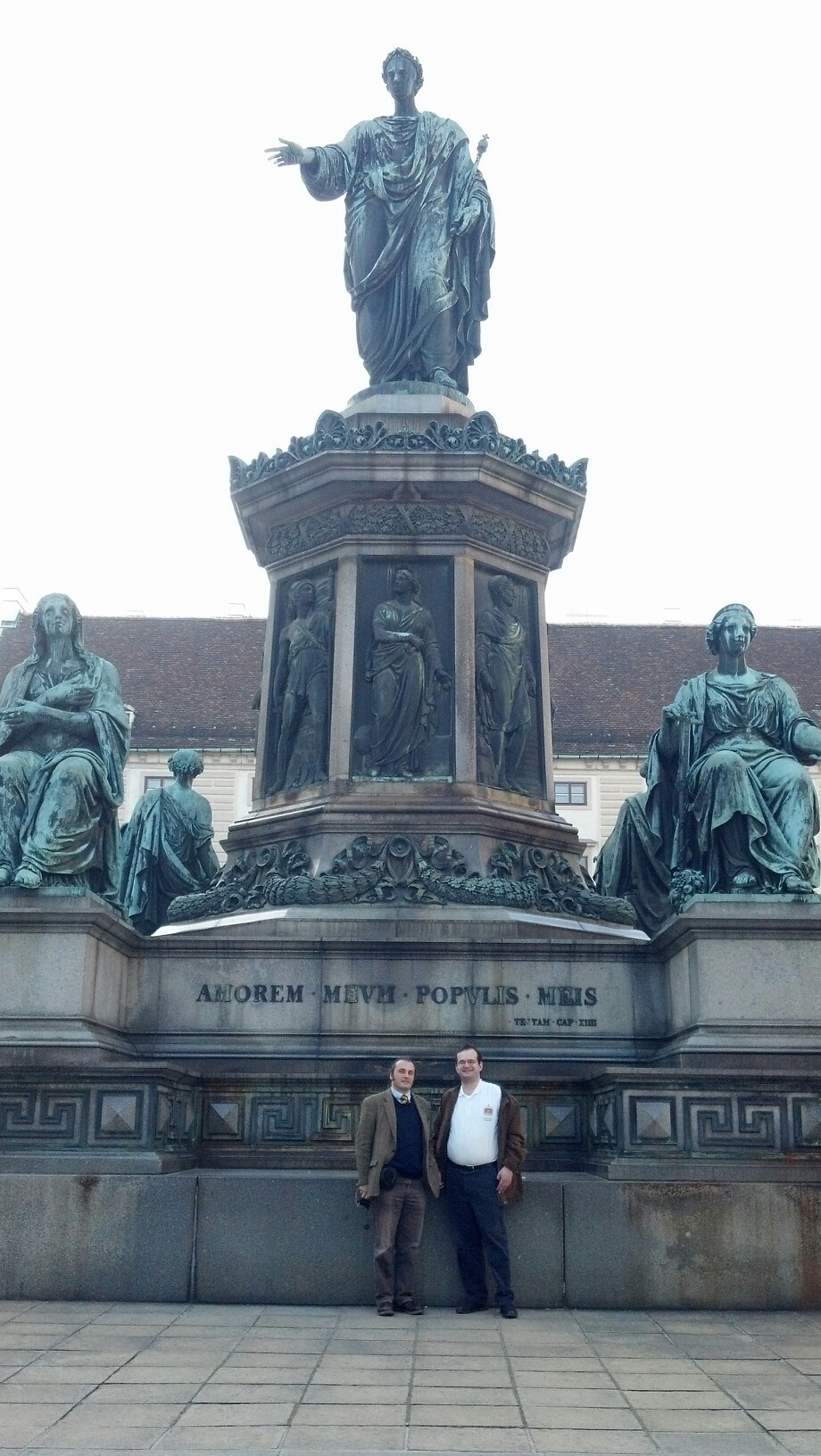
(with Alexander Simec at the statue of Emperor Franz II/I at the Hofburg in Vienna on 16 March)
The most meaningful and moving landmark I visited was the Hofburg in Vienna, including the imperial treasury (featuring the regalia of the Holy Roman Empire including the great crown made for Otto the Great in 962), the imperial apartments of Franz Joseph and Elisabeth, and the Capuchin crypt where Habsburgs have been buried for the past four centuries. My generous and helpful guides in Vienna were Austrian monarchist Alexander Simec and his wife Gertrud of the Schwarz-Gelbe Allianz. I had very little free time in Munich, once the capital of the Kingdom of Bavaria, but enjoyed exploring Hamburg including the nineteenth-century Rathaus with its facade of Holy Roman Emperors (since as a Free City Hamburg owed allegiance only to the Emperor). In Frankfurt I had dinner with a German monarchist friend before our concert at the Alte Oper, which had been opened by Emperor Wilhelm I in 1880. My trip ended in the Kingdom of Belgium, where a much smaller orchestra performed two private concerts on the estate of a fairytale castle. As strange as it may be most of the time for a monarchist to live in Dallas, I am fortunate to be in a profession which occasionally provides ample opportunities for activities related to my interests and beliefs.
(with Alexander Simec at the statue of Emperor Franz II/I at the Hofburg in Vienna on 16 March)
Friday, May 18, 2012
Royalty of the World at Windsor

Front row (L-R): HIM the Emperor of Japan, HM the Queen of the Netherlands, HM the Queen of Denmark, HM the King of the Hellenes, HM the King of Romania, HM the Queen of the United Kingdom, HM the King of Bulgarians, HM the Sultan of Brunei, HM the King of Sweden, HM the King of Swaziland, HSH the Prince of Liechtenstein.
Middle row (L-R): HSH the Prince of Monaco, HRH the Grand Duke of Luxembourg, HM the King of Lesotho, HM the King of the Belgians, HM the King of Norway, HH the Emir of Qatar, HM the King of Jordan, HM the King of Bahrain, HM the Yong di-Pertuan Agong of Malaysia.
Back row (L-R): HH Prince Nasser Mohamed of Kuwait, HH the Crown Prince of Abu Dhabi, HRH the Crown Prince of Yugoslavia, HM the King of Tonga, HRH the Crown Prince of Thailand, HRH Princess Lalla Meryem of Morocco, HRH Prince Mohammed bin Nayaf of Saudi Arabia.
Apparently that April 22 Telegraph article was much ado about nothing, as the former King of the Hellenes attended the Queen's Diamond Jubilee lunch after all, with no earth-shattering consequences, whatever Greek republicans say, resulting in a wonderful unique photograph (perhaps the most comprehensive ever taken) of most of the world's reigning monarchs. Other members of the British royal family including the Duke & Duchess of Cambridge joined the Queen in welcoming this illustrious international assembly of royalty to Windsor Castle. The absence of Queen Sofia and any representative of the royal families of Cambodia, Bhutan, and Oman is to be regretted, though monarchists can rejoice to see not only King Constantine but also the former kings of Romania and Bulgaria and the crown prince of Yugoslavia included. Discussion however has been dominated by the presence of the controversial Kings of Bahrain and Swaziland, though I doubt most British people really mind nearly as much as noisy troublemakers apparently think they should. Once again I say the Queen can invite who she likes; it's not as if democratic republican governments never host controversial republican heads of state!
Wednesday, August 17, 2011
Back from Europe
On Monday I returned from my trip to Europe, one of my best travel experiences yet. I'm not sure how to adequately summarize the four weeks in a blog post, but readers are welcome to find me on Facebook where I've posted nearly 400 photos of sites, many of them with royal connections, in England, Belgium, and Germany. (My Facebook photos are not protected so you should be able to see them even if you're not my Friend. I have nothing to hide!) Monarchical highlights included meeting up with fellow monarchists from Britain and Australia in Canterbury and London, singing services for the first time in St George's Chapel where Henry VIII, Charles I, George III, Edward VII, George V, George VI, and many other royalty are buried, visiting Dover Castle in Kent and Queen Victoria's favourite home Osborne House on the Isle of Wight, seeing the remnants of the palace where Emperor Charles V was born in Ghent, visiting Charlemagne's cathedral in Aachen, and seeing the tombs of King John and Prince Arthur Tudor in Worcester. Now that I'm back at my own computer, blogging will hopefully resume its former frequency!
Here is a photo of my choir on the steps of St George's Windsor (24 July), and here we are at Westminster Abbey (31 July).
Here is a photo of my choir on the steps of St George's Windsor (24 July), and here we are at Westminster Abbey (31 July).
Saturday, July 16, 2011
England/Belgium 2011
Ironically, blogging may be a bit light as I spend the next four weeks in two of Europe's seven remaining kingdoms, Britain and Belgium. I will be singing daily services with the choir of the Church of the Incarnation in Canterbury Cathedral (July 18-21), St George's Chapel Windsor Castle (July 23-24), and Westminster Abbey (July 25-31). Music lists (subject to change) are here and here. Following the choir tour I plan to visit a friend in Antwerp, Belgium, after which I will return to England for the Three Choirs Festival in Worcester (August 6-13). Please contact me if you are a reader of this blog who lives near any of those places! I look forward to what should be an exciting trip, my fifth visit to the United Kingdom and my first to the Kingdom of Belgium.
Monday, June 20, 2011
Succession "reform," again...
Hopefully these latest efforts to abolish male primogeniture and repeal the Act of Settlement will prove too complicated and go nowhere. Sometimes I find the "modernisers" almost as annoying as republicans. "Fairness" and "Equality" are not the point of a hereditary monarchy. How is it any more fair to favour the eldest child? Doesn't that "discriminate" against younger siblings? (Not to mention people not born into the royal family, as republicans--who are at least consistent, much as I despise them--will point out.) Is there no one in Government who will point this out and obstruct the nonsensical egalitarian agenda?
Asked by a liberal Dutch monarchist to address the point that to him hereditary succession itself seems more rational than favouring males over females, I responded at my forum that one rational argument is that republicans especially in the Commonwealth countries would do their utmost to turn the necessary debate into one on the very existence of the monarchy itself. Most of us would rather not open that can of worms.
The Kingdom of the Netherlands is relatively new, a creation of the post-Napoleonic era, so it is perhaps somewhat more appropriate for it and its even younger neighbour the Kingdom of Belgium to "move with the times" to a certain extent (though I don't really agree with the adoption of equal primogeniture there either). But the British Monarchy with its roots in the ninth century is all about Tradition, and the tradition there has been for male monarchs to be the norm (even if it doesn't quite seem like it due to three female monarchs having had exceptionally long reigns), with queens regnant the exception. Personally as an admirer of Elizabeth I, Victoria, and Elizabeth II I think that female monarchs shine when they are the exception, having come to the throne due to the absence of any (living) brothers.
I would consider it a travesty for Prince William's eldest son to be bypassed by a sister, which with the unique exception of Prince James Stuart (1688-1766) (hardly analogous to the present situation; somehow I doubt the "Glorious Revolution" was motivated by concern for gender equality) has never happened before in the history of the British monarchy. It is natural, and in accord with most monarchical traditions, for the eldest son of a king to expect to be king in turn, and cruel to deny that to him as it has been denied to Prince Carl Philip of Sweden (b 1979) whose sister Crown Princess Victoria (b 1977) would probably have preferred not to be heir to the throne. [In the Netherlands, ruled by Queens since 1890, it's a moot point at present since Prince Willem-Alexander has three daughters and no sons, but in Belgium Princess Elisabeth (b 2001) precedes her brother Prince Gabriel (b 2003), which still seems odd to me.]
Asked by a liberal Dutch monarchist to address the point that to him hereditary succession itself seems more rational than favouring males over females, I responded at my forum that one rational argument is that republicans especially in the Commonwealth countries would do their utmost to turn the necessary debate into one on the very existence of the monarchy itself. Most of us would rather not open that can of worms.
The Kingdom of the Netherlands is relatively new, a creation of the post-Napoleonic era, so it is perhaps somewhat more appropriate for it and its even younger neighbour the Kingdom of Belgium to "move with the times" to a certain extent (though I don't really agree with the adoption of equal primogeniture there either). But the British Monarchy with its roots in the ninth century is all about Tradition, and the tradition there has been for male monarchs to be the norm (even if it doesn't quite seem like it due to three female monarchs having had exceptionally long reigns), with queens regnant the exception. Personally as an admirer of Elizabeth I, Victoria, and Elizabeth II I think that female monarchs shine when they are the exception, having come to the throne due to the absence of any (living) brothers.
I would consider it a travesty for Prince William's eldest son to be bypassed by a sister, which with the unique exception of Prince James Stuart (1688-1766) (hardly analogous to the present situation; somehow I doubt the "Glorious Revolution" was motivated by concern for gender equality) has never happened before in the history of the British monarchy. It is natural, and in accord with most monarchical traditions, for the eldest son of a king to expect to be king in turn, and cruel to deny that to him as it has been denied to Prince Carl Philip of Sweden (b 1979) whose sister Crown Princess Victoria (b 1977) would probably have preferred not to be heir to the throne. [In the Netherlands, ruled by Queens since 1890, it's a moot point at present since Prince Willem-Alexander has three daughters and no sons, but in Belgium Princess Elisabeth (b 2001) precedes her brother Prince Gabriel (b 2003), which still seems odd to me.]
Tuesday, January 4, 2011
Nine Kings 1910
I should have compiled this page in time for the centennial of the death of King Edward VII in May 2010, but didn't think of it until tonight. Here is a tribute to one of my favourite photographs of royalty: the nine kings who assembled in London for Edward VII's funeral in 1910. I wish that someone with the power to bring it about had had my idea of re-creating the photo a hundred years later with those kings' present-day heirs.
Monday, September 20, 2010
"Scandal-Ridden" Monarchies?
Canadian publication Maclean's irreverently profiles Europe's surviving monarchies. Writer Patricia Treble exaggerates the importance of various "scandals" and (as RadicalRoyalist points out) ignores the rather more serious problems plaguing republics such as Germany's, but concludes that monarchies are "good fun" and acknowledges that republics are no cheaper. Serious monarchists, however, are likely to regret that "good fun" is the extent to which modern monarchies are all too often appreciated, and may be forgiven for wondering if the marital decisions of younger royalty might indeed have something to do with it.
Thursday, May 27, 2010
Modern Monarchy and the Boston Globe
Recently The Boston Globe published an interesting reflection on the place of monarchs in the modern world, Saved by the crown. From violent protests in Thailand to parliamentary politics in Britain and Belgium, the role of the Crown has attracted attention in recent months. If people like Council on Foreign Relations Fellow Joshua Kurlantzick (who doesn't exactly seem like a monarchist but at least understands that contemporary constitutional monarchs can be more than decorations) are taking monarchy seriously, that's an encouraging sign.
It's unfortunate that these days Monarchy is likely to be defended only in terms of what it can do for Democracy and Modernity, but that's probably the best monarchists can expect from a mainstream publication such as the Globe. I do not, of course, agree with all of the article's assumptions, particularly the astonishing claim that "where kings and sultans still actually rule...monarchs can be every bit as oppressive and opaque as any other dictatorship." On the contrary, I think it's a pretty fair generalization that with the possible exception of Saudi Arabia (probably my least favorite current monarchy), throughout the Muslim world it is the monarchies that consistently are and have been the most reasonable regimes, from both non-Muslim and female perspectives, and even Saudi Arabia's current King Abdullah is not without his relatively progressive initiatives, as the article admits.
As far as Europe is concerned, it's worth noting that the arguably problematic "Constitutional Monarchs Help Facilitate Democracy and Multiculturalism" defense is one reason why many right-wingers today have no interest in monarchy. I myself would confess to be less than entirely comfortable with modern European royalty's apparent acquiescence to the massive changes being imposed on their societies via mass immigration, not to mention other troubling developments such as the emasculation and destruction of the House of Lords in Britain. But it's nevertheless a legitimate point that, like it or or not, these situations have been brought about by governments elected by the peoples of those countries, and the royals really have no choice but to make the best of them. Perhaps constitutional monarchy in countries like Sweden and the Netherlands really will be the glue that prevents immigration from having the most dire consequences feared by many on the Right and somehow makes modern Europe work in spite of itself.
If that's the case, people (especially politicians) in former monarchies from Serbia to Laos would do well to pay attention to The Boston Globe. For what this article proves is that one need not be a reactionary alienated from modernity and its democratic values to see the value of kings and queens. On many fronts, pure traditionalists frankly have lost, and reversal seems unlikely. But if the advantages of restoration of monarchy can be appreciated even from a generally modernist perspective, there is no reason to give up on this particular front. Symbols matter, and are worth fighting for, even--or perhaps especially--if they mean different things to different people. So whether you see the Crown as the embodiment of the traditional civilisation you nostalgically prefer to the present, or as an effective tool for addressing the problems of modernity capable of endless reinvention and adaptation, or even some combination of the two, join the fight for the restoration and preservation of monarchies! Even The Boston Globe understands.
It's unfortunate that these days Monarchy is likely to be defended only in terms of what it can do for Democracy and Modernity, but that's probably the best monarchists can expect from a mainstream publication such as the Globe. I do not, of course, agree with all of the article's assumptions, particularly the astonishing claim that "where kings and sultans still actually rule...monarchs can be every bit as oppressive and opaque as any other dictatorship." On the contrary, I think it's a pretty fair generalization that with the possible exception of Saudi Arabia (probably my least favorite current monarchy), throughout the Muslim world it is the monarchies that consistently are and have been the most reasonable regimes, from both non-Muslim and female perspectives, and even Saudi Arabia's current King Abdullah is not without his relatively progressive initiatives, as the article admits.
As far as Europe is concerned, it's worth noting that the arguably problematic "Constitutional Monarchs Help Facilitate Democracy and Multiculturalism" defense is one reason why many right-wingers today have no interest in monarchy. I myself would confess to be less than entirely comfortable with modern European royalty's apparent acquiescence to the massive changes being imposed on their societies via mass immigration, not to mention other troubling developments such as the emasculation and destruction of the House of Lords in Britain. But it's nevertheless a legitimate point that, like it or or not, these situations have been brought about by governments elected by the peoples of those countries, and the royals really have no choice but to make the best of them. Perhaps constitutional monarchy in countries like Sweden and the Netherlands really will be the glue that prevents immigration from having the most dire consequences feared by many on the Right and somehow makes modern Europe work in spite of itself.
If that's the case, people (especially politicians) in former monarchies from Serbia to Laos would do well to pay attention to The Boston Globe. For what this article proves is that one need not be a reactionary alienated from modernity and its democratic values to see the value of kings and queens. On many fronts, pure traditionalists frankly have lost, and reversal seems unlikely. But if the advantages of restoration of monarchy can be appreciated even from a generally modernist perspective, there is no reason to give up on this particular front. Symbols matter, and are worth fighting for, even--or perhaps especially--if they mean different things to different people. So whether you see the Crown as the embodiment of the traditional civilisation you nostalgically prefer to the present, or as an effective tool for addressing the problems of modernity capable of endless reinvention and adaptation, or even some combination of the two, join the fight for the restoration and preservation of monarchies! Even The Boston Globe understands.
Wednesday, April 29, 2009
The Big Question
Prompted by rumors of an imminent abdication in the Netherlands, The Independent ponders the future of European monarchy.
Monday, March 2, 2009
New Genealogical Tables
I have long been interested not only in the monarchist cause and royal history but also in the minutiae of European royal genealogy. Recently, as a follow-up to a comment of mine on a thread at my monarchist forum on the engagement of Crown Princess Victoria of Sweden about relationships between reigning European monarchs eventually growing more distant as unequal marriages continue to be the norm, I prepared this table of relationships between current European sovereigns. Liking the way the table looked and inspired to attempt a bigger challenge, I then prepared this similar table for 1914. I am grateful to forum member Peter for his help in revising and refining the tables; our discussion is here in the thread on which I originally posted them.
Monday, December 8, 2008
Royal Wedding in Belgium
Thursday, November 13, 2008
Prince Charles at 60 (5)
The Telegraph reports, without any real evidence, that King Charles III will be known as "Defender of Faith" rather than "Defender of the [Anglican] Faith." I wonder what such tinkering would accomplish; after all, the original Latin (Fidei Defensor) would be unaffected.
I've never understood the idea that explicitly identifying the British monarch with Anglicanism is offensive to non-Anglicans. While it is true that I now attend an Episcopal church, I was once a very secular sort of a monarchist, and then for 2-3 years felt more or less aligned with Roman Catholicism; during neither of those periods did it ever occur to me that this particular title of Elizabeth II's would have somehow excluded me from the benefits of being one of her subjects, had I been lucky enough to be one. It seems to me that religious people of all faiths benefit from a monarchy that acknowledges a spiritual dimension and is committed to the defense of its own religious tradition, since one cannot truly defend them all. Even an atheist or agnostic ought to be able to acknowledge the special relationship that Christianity in general and Anglicanism in particular had with the development of British culture. The fact is that Britain for some time (especially since the 1829 Catholic Emancipation) has had a deserved reputation as a land tolerant of various faiths, and of secularism, for rather longer than many European countries, and the monarch's status as "Defender of the Faith" has not interfered with that. So why get rid of it now?
Additionally, it might be reasonably objected that changing the title to "Defender of Faith" implies a new and unnecessary opposition between the monarchy and modern Britain's many non-religious people, in a way that simply leaving it as it is does not.
An alert member of my forum pointed out that the Telegraph article's list of royal guests is rather remarkable in its errors. "Prince Mary" of Denmark should of course be "[Crown] Princess Mary," and "Felipe" and "Matilda" of Belgium should be "Philippe" and "Mathilde."
I've never understood the idea that explicitly identifying the British monarch with Anglicanism is offensive to non-Anglicans. While it is true that I now attend an Episcopal church, I was once a very secular sort of a monarchist, and then for 2-3 years felt more or less aligned with Roman Catholicism; during neither of those periods did it ever occur to me that this particular title of Elizabeth II's would have somehow excluded me from the benefits of being one of her subjects, had I been lucky enough to be one. It seems to me that religious people of all faiths benefit from a monarchy that acknowledges a spiritual dimension and is committed to the defense of its own religious tradition, since one cannot truly defend them all. Even an atheist or agnostic ought to be able to acknowledge the special relationship that Christianity in general and Anglicanism in particular had with the development of British culture. The fact is that Britain for some time (especially since the 1829 Catholic Emancipation) has had a deserved reputation as a land tolerant of various faiths, and of secularism, for rather longer than many European countries, and the monarch's status as "Defender of the Faith" has not interfered with that. So why get rid of it now?
Additionally, it might be reasonably objected that changing the title to "Defender of Faith" implies a new and unnecessary opposition between the monarchy and modern Britain's many non-religious people, in a way that simply leaving it as it is does not.
An alert member of my forum pointed out that the Telegraph article's list of royal guests is rather remarkable in its errors. "Prince Mary" of Denmark should of course be "[Crown] Princess Mary," and "Felipe" and "Matilda" of Belgium should be "Philippe" and "Mathilde."
Saturday, May 31, 2008
Cusack on the Crown
Writing at Taki's Magazine, Andrew Cusack eloquently laments the fact that HM Queen Elizabeth II will probably sanction the Human Fertilisation and Embryology Bill, a piece of legislation which certainly seems to be contrary in principle to any serious concept of a Christian Monarchy, which the United Kingdom nominally still is. While Mr. Cusack makes good points, it remains my position that HM cannot and should not be blamed for consistently acting within the constraints of modern constitutional monarchy, according to which the sovereign is expected to automatically sign any bill passed by the legislature. We have seen in Europe and elsewhere what has happened to monarchs who have strayed outside the "democratic" box. It should also be noted that none of the modern examples of British or Commonwealth royal intervention cited by Mr. Cusack involved an attempted royal veto of any legislation approved by the elected government, and even King Baudouin's defiant gesture on abortion was obviously not effective. While a relatively activist style of monarchy has been fairly successful in the Principality of Liechtenstein, the last European King who clashed with his government was Constantine II of Greece--now in exile for the past 40 years.
Traditionalists who long for a more active Crown should think of modern royalty as prisoners in a golden cage, in which case it is up to us to rescue them. We can start by trying to combat the false belief that only those who have won elections are entitled to have any real influence in government. But for the time being, that is the way Britain works, and it is the MPs who voted for this bill, and the ordinary people who voted for them, not the Queen, who should be held responsible for it. I doubt that even all of those opposed to this Bill would wish for it to be defeated via royal veto, so deeply ingrained is the democratic mindset even among "conservatives."
Traditionalists who long for a more active Crown should think of modern royalty as prisoners in a golden cage, in which case it is up to us to rescue them. We can start by trying to combat the false belief that only those who have won elections are entitled to have any real influence in government. But for the time being, that is the way Britain works, and it is the MPs who voted for this bill, and the ordinary people who voted for them, not the Queen, who should be held responsible for it. I doubt that even all of those opposed to this Bill would wish for it to be defeated via royal veto, so deeply ingrained is the democratic mindset even among "conservatives."
Wednesday, April 16, 2008
New Belgian Princess
Congratulations to Prince Philippe and Princess Mathilde of Belgium on the birth of their fourth child, Princess Eleonore Fabiola Victoria Anne Marie, today in Anderlecht. Princess Eleonore shares a birthday with both Pope Benedict XVI (81 today) and Queen Margrethe II of Denmark (68 today).
Subscribe to:
Posts (Atom)