Showing posts with label France. Show all posts

Monday, March 13, 2023

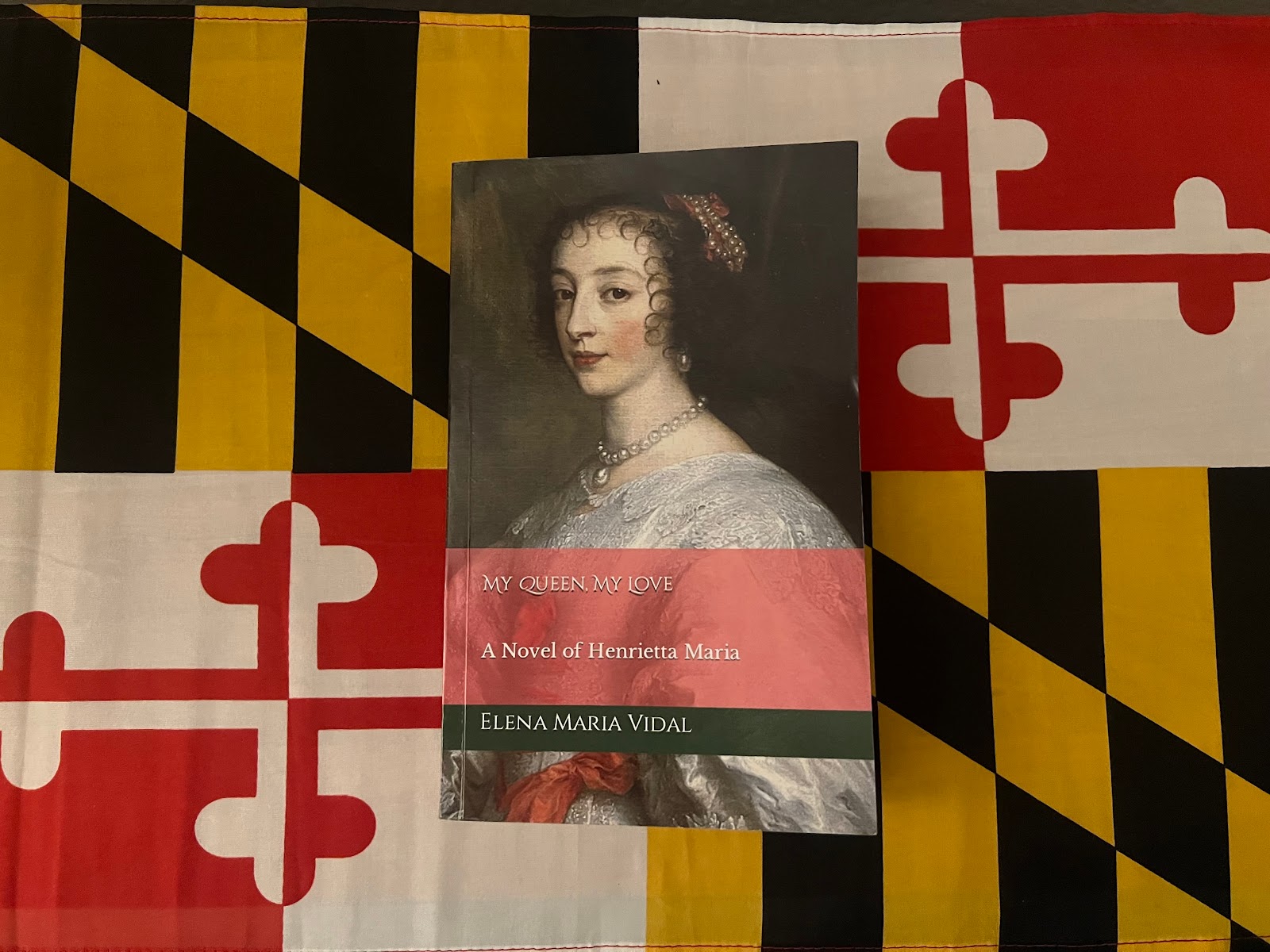
Review: Elena Maria Vidal's "My Queen, My Love"


Most Americans are probably not aware that the US state of Maryland was originally named after Queen Henrietta Maria (1609-1669), daughter of King Henri IV of France (1553-1610) and wife of the ill-fated King Charles I of England (1600-1649). Readers seeking an introduction to this unjustly neglected historical figure would do well to immerse themselves in this charming and engaging book by Elena Maria Vidal, who appropriately enough lives in Maryland.

"My Queen, My Love," which covers the title character's life from her childhood in France through the births of her own children in the 1630s on the eve of the English Civil War, is a historical novel, so includes fictionalized dialogue, but is firmly based on historical research like any biography. Its style vividly brings the complex and colourful world of the 17th century to life, from Italy [homeland of her mother Marie de Medici (1573-1642)] to France to England. The central importance of religion is evident from the outset. Daughter of the pragmatic convert Henri IV, the devoutly Catholic Henrietta Maria finds herself in an impossible situation as wife of the staunch Anglican Charles I in what is by then a predominantly and fervently Protestant country, with even the King's own high church Anglicanism increasingly deemed too "catholic" by some. While the author clearly shares Henrietta Maria's devout Roman Catholicism, it is to Vidal's credit that the sincerity of King Charles who believes that his Church of England is truly Catholic is depicted in a well-rounded manner. I particularly appreciated the writer's evident love of liturgical beauty as reflected in lavish descriptions of Catholic ceremonies including sacred music. Henrietta Maria's enjoyment of the secular arts, so scandalous to the dour Puritans especially her own participation in Masques, is a consistent theme as well.

Anglicans like me who revere Charles as a Martyr, aware of his and his wife's fervent loyalty to each other during the terrible trials of the Civil War which (after the time period covered by this book) would end in his execution and her widowhood, are accustomed to thinking of their marriage as an ideal devoted Christian one, as indeed it later became. However it must be admitted that this was not always the case. While vaguely aware that King Charles and Queen Henrietta Maria had had difficulties in the early years of their marriage, I had not thought much about the details until I read this book. One sensitive issue is that in order to gain French approval for their 1625 marriage Charles had had to make various promises, particularly those related to the Queen's Catholicism, that once back in England he finds himself unable to keep. It particularly galls her, understandably, that money from her dowry ended up being used to fund a war with her native France! While Vidal's Henrietta Maria never falters in her ultimately heroic love for Charles, the reader can also see without dismissing his point of view how Charles might have felt frustrated at times.

To the extent that the narrative of the challenging early years of their marriage has a villain, it is surely George Villiers, Duke of Buckingham (1592-1628). A favourite of Charles's father James I (1566-1625), Buckingham continues his leading role in British affairs as a sort of substitute older brother (Charles's real older brother Henry having sadly died at 18 in 1612) of the young and insecure new king. Wary of losing his pre-eminence should the Queen replace him as the King's most trusted confidant, Buckingham (though capable of great charm) does everything he can to undermine the Queen's position and behaves with shocking disrespect to her, while also being egotistically heedless of his unpopularity among the common people who tend to blame him rather than the King for the failures of his aggressive foreign policy. Charles either cannot or will not see this other side of him, and when Buckingham meets his end the reader is likely to feel that he had it coming. Whether the final chapter's theory about who was ultimately behind the assassination is true, I cannot say, but there is no doubt that Buckingham's death finally smoothes the path for Charles and Henrietta Maria to eventually enjoy a happier marriage.

Whether new to the period or an experienced student of Stuart history, any reader will be sure to finish this delightful book knowing Queen Henrietta Maria better than before, almost like a personal friend. I highly recommend it to anyone interested in royal history and look forward to further installments as given her tumultuous life there is certainly more material to come.


Friday, February 24, 2023

175 Years Without A French King

Today is the 175th anniversary of the abdication (24 February 1848) of the last French king to date, Louis Philippe (1773-1850). The fall of the "July Monarchy," itself a product of the revolt against the last Legitimist Bourbon king Charles X (1757-1836) eighteen years earlier, was the first of the Revolutions of 1848, which shook thrones across Europe, with Bavarian and Austrian monarchs also abdicating, though only the French Bourbon-Orléans dynasty lost their throne entirely. With the fall of Louis Philippe (a direct male-line descendant of Louis XIII), the last compromise between the Capetian dynasty that had reigned in France since 987 (except for the period between 1792 and 1814) and the more moderate components of the legacy of the French Revolution failed, and while there would be one more Emperor, no more Kings have reigned in France since then. 🇫🇷

Supported by the new liberal capitalist bourgeoisie, the initially popular Louis Philippe (who reigned as "King of the French" rather than "King of France") never won the hearts of either the traditional Right (who resented his 1830 usurpation) or the growing industrialized working classes. ("Les Miserables" depicts, not the original French Revolution, but a much smaller unsuccessful 1832 revolt against Louis Philippe's government by those unhappy that ousting Charles X had not resulted in a Republic.)

Not wishing to share the fate of his cousin Louis XVI (for whose death his pro-Revolutionary father had voted before meeting the same fate himself), he quickly fled to England where he spent the last two years of his life. (Louis-Philippe's wife, Queen Marie-Amelie (1782-1866), was a niece of the executed Queen Marie Antoinette.)

Many modern Catholic royalty are descended from Louis Philippe, including the present kings of Belgium and Spain. Since the extinction of the senior Bourbon line in 1883, many (most?) French royalists have accepted his descendants as rightful heirs not only to the 1830-48 constitutional monarchy but to the ancient French monarchy, currently claimed by Prince Jean, Comte de Paris. 

May France one day return to her one true form of government, the Monarchy!


Tuesday, April 12, 2022

The Real French Choice

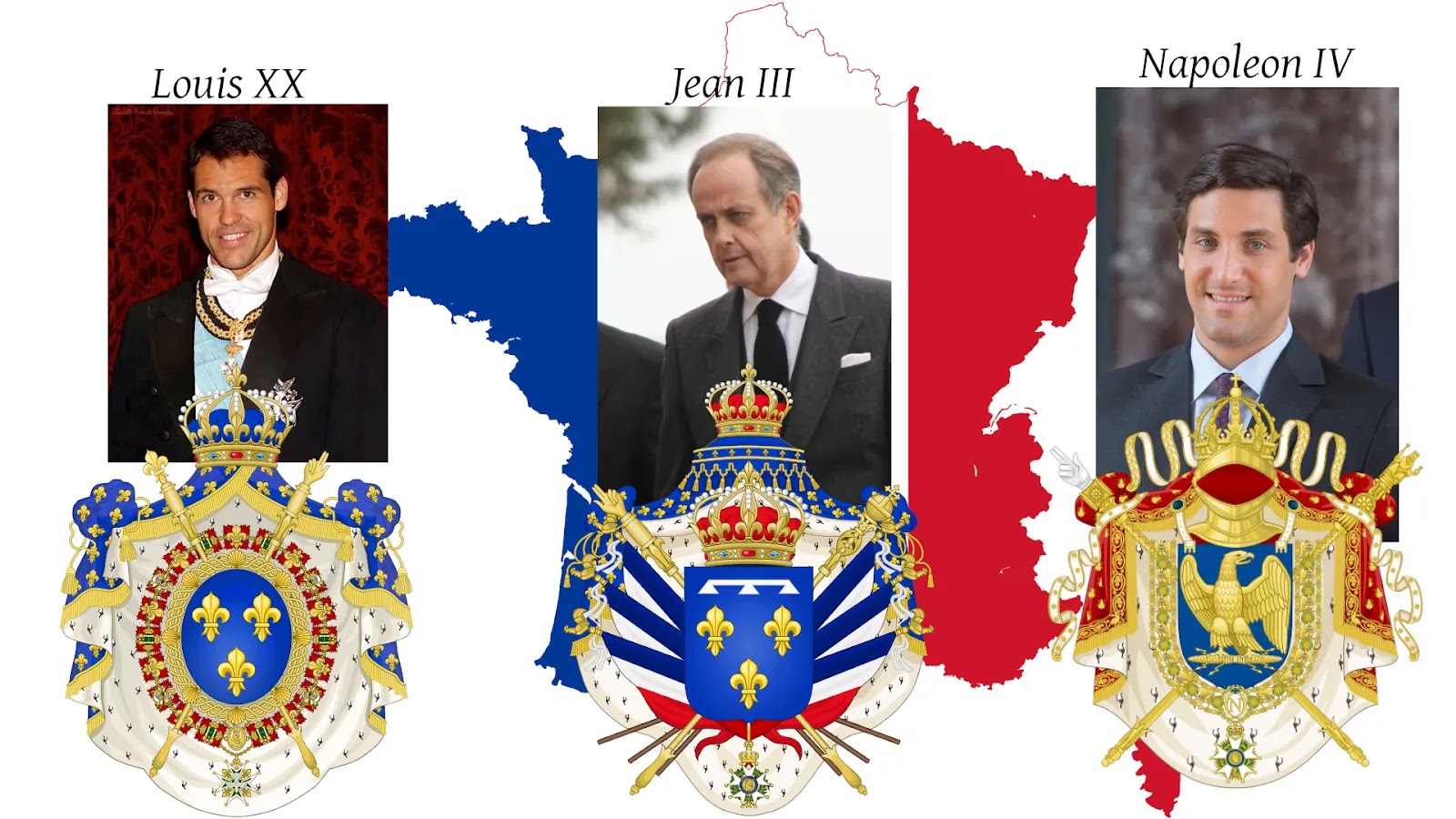
As France for some reason prepares for yet another presidential election, let's remember what the only real choice is. (I don't take Bonapartism very seriously, but I have a few monarchist friends who lean that way, and I do respect Prince Jean-Christophe and his genealogically splendid marriage.) 

This would be a fantastic graphic if only the numbers were correct. But it is inconsistent to count Louis XIX (1775-1844) (who might have nominally reigned for a few minutes in 1830 and was the senior Bourbon from 1836) and Louis XVII (1785-1795) (who never reigned at all but thanks to the subsequent restoration of his uncle Louis XVIII is universally counted) but not the de jure monarchs of the Orléans and Bonaparte lines. Jean should be Jean IV, in honour of his great-grandfather Jean Duke of Guise (1874-1940), who would have been "Jean III" from 1926. Meanwhile Napoleon would be Napoleon VII. ["Napoleon IV" was the Prince Imperial (1856-1879), followed by "Napoleon V" Victor (1862-1926), followed by the present pretender's grandfather "Napoleon VI" Louis (1914-1997).] I wish I knew how to do things like that.


Monday, March 14, 2022

Micaela, Countess of Paris (1938-2022)

HRH the Dowager Countess of Paris, née Micaela Cousiño, second wife of the late Count [regarded by many royalists as King Henri VII of France (1933-2019)], has died at the age of 83. May she rest in peace.


Thursday, August 12, 2021

The truth about the French Revolution

Gerald Warner demolishes the myths on which the modern French Republic is built. Tuesday was the 229th anniversary of the (first) temporary abolition of the ancient French Monarchy, but royalists will never give up. Vive le Roi!


Sunday, June 13, 2021

Hélène d'Orléans 150

One hundred fifty years ago today, Princess Hélène of Orléans (1871-1951) was born at York House in Twickenham, England. Daughter of the Count of Paris, Orléanist claimant to the French throne, following the fall of the Second Empire she spent most of her childhood in France, until the insecure Third Republic exiled them again in 1886 following exuberant royalist celebrations of her older sister Amélie's marriage to the Crown Prince (later King) of Portugal. Thus the Orléans family returned to England and became close to the British royal family. Hélène and Prince Albert Victor (1864-1892), eldest son of the Prince of Wales, fell in love and wished to marry, and Queen Victoria was fond of her, but the religious difference proved insurmountable.

Instead Hélène married in 1895 Italy's Prince Emanuele Filiberto (1869-1931), Duke of Aosta, a nephew of King Umberto I, whose own father had briefly reigned as King of Spain, and who was next in line to the Italian throne until the birth of Crown Prince Umberto in 1904. The marriage produced two sons, Amedeo (1898-1942) and Aimone (1900-1948), but was not happy; Hélène became known for her adventurous solo travels in Africa and for her heroic humanitarian work with the Red Cross. Her life was marked by tragedies, such as the murder of her brother-in-law and nephew in Portugal in 1908, the devastation of the two World Wars, and outliving both of her sons as well as the Italian monarchy she had served for half a century. Hélène was the grandmother of Prince Amedeo (1943-2021) who died recently, as well as two princesses who survive. Edward Hanson's biography "The Wandering Princess" is a fascinating window into a long and unconventional royal life that spanned and was shaped by the major upheavals of modern European history.


Saturday, September 5, 2020

Louis XVI, Death, and Vandalism


I have to censor myself a bit when things like the vandalism and resultant removal of the Louisville Louis XVI statue happen, because I don't want to get in trouble. But I think I can say this. The truth is that I tend to react to news of the deliberate damage or destruction of art, especially art that is specifically symbolic of my beliefs and interests, with a kind of instinctive visceral rage that I generally simply don't experience at news of deaths, even unjust ones, of people I had never heard of. Maybe this makes me a bad person, but it's how I honestly feel.

I'm sure this has a lot to do with the fact that I'm in the arts, though I don't think all musicians are like this. While I work in the performing, rather than the visual, arts, my respect for competent visual artists is such that it's not hard to see an attack on a beautiful (or even just technically proficient) statue as an expression of contempt for the labor of all artists and therefore on my vocation. The subject of the art in question does not have to be as close to my heart as Louis XVI is for me to feel that way: I'm obviously not a Buddhist, but the Taliban's 2001 destruction of the 6th century Bamyan Buddhas still horrifies me too.
 
But it's also about the fact that, whether we like it or not, death is inevitable for all human beings, whereas a statue or artwork or building can last indefinitely for multiple future generations if not deliberately destroyed. And with over seven billion people on the planet, no matter how empathetic we think we are (and I freely acknowledge that there are people more empathetic and humanitarian than I am) we simply cannot grieve for every death, even every publicized one, or we would do nothing else. There is a finite amount of man-made beauty in the world, but an apparently infinite number of idiots who do not appreciate it.
 
I am outraged as an American monarchist because there were very few statues of royalty in the USA to begin with and now one of the most notable ones has been so severely damaged that it probably cannot ever be safely displayed in public again. But even if a statue of King Louis XVI per se is not as important to you as it is to me, the arts in general (including sculpture) are essential to what make life worth living for those of us who are alive. And no cause can justify or excuse such wanton contempt for human creation, history, the integrity of public spaces, or the legacy of a kind and decent man to whom all who do believe in the United States of America owe their independence and who ultimately paid for agreeing to become the USA's first foreign ally with his life.


Friday, August 28, 2020

St. Louis 750 in St. Louis

On Tuesday I spent the 750th anniversary of the death of King St. Louis IX of France (also the 175th birthday of King Ludwig II of Bavaria) in St. Louis, the American city named for him founded in 1764. Here I am (in my “Vive le Roi!” shirt) at the famous statue (previously visited in 2015), “Apotheosis of Saint Louis.”


Sunday, June 28, 2020

Saint Louis Under Attack

The Apotheosis of Saint Louis (1906), St. Louis, Missouri

I'm going to have to be careful what I say about this, as it makes me very angry. I think it will suffice for now to say that while I am an Episcopalian, if I lived in St. Louis I would have been there in solidarity with the Catholic defenders of the statue yesterday. Monarchists in the USA don't exactly have a lot of public monuments we can relate to, and this one is probably the best, and closest to my heart since my 2015 visit. Saint Louis, pray for us!

Here is another article. I left the following comment on the St. Louis Post-Dispatch Facebook page: "This diabolical campaign does not deserve any respect. King Saint Louis IX was a good man and a hero. I am an Episcopalian, but if I lived in St. Louis I would have been with the Catholics defending the statue. American monarchists like me have very few public monuments we can relate to and this one is the best and closest to my heart. This should not even be presented as a legitimate controversy. The statue's radical enemies seek only destruction and have nothing positive to contribute to society. How can anyone in St. Louis even contemplate the eradication of their city's French Catholic heritage and name? St. Louis had nothing to do with American racial problems and should not be associated with them. This movement displays gross historical ignorance and attempts to judge a 13th-century French king by modern politically correct standards. Virtually any medieval European Catholic would be considered "anti-Semitic" and "Islamophobic" by contemporary standards. That doesn't mean they can't or shouldn't be honored for the good things they did within the framework of the only society they knew. Shame on the St. Louis authorities for not making sure the statue was protected before yesterday."

Statement from the Archdiocese of St. Louis.

I just signed this petition and urge others to do the same. I've also ordered a miniature copy of the statue from the St. Louis Art Museum.


Saturday, May 30, 2020

Louis XVI statue vandalized in Louisville

I am furious that the statue in Louisville of its martyred namesake King Louis XVI (1754-1793), who had nothing to do with American police brutality and in fact attempted to reform the French criminal justice system and tended to err on the side of leniency, has been vandalized. ⚜️

From Charles Coulombe: The attack on the Louis XVI statue in Louisville is ironic on several levels: Louis XVI wanted to buy out the slaveowners and liberate their slaves as early as 1777 - he thought he would be able to do so in ten years at the rate his reforms were working, but the next year made the biggest error of his reign: intervening in the American rebellion. Although that intervention made rebel victory possible (hence the statue and the town being named after him), it turned George III (who felt betrayed by Louis) against Catholic emancipation, and bankrupted France. Not only was there no money to free the slaves, there was none to feed the French peasantry when an Icelandic volcano spoiled the 1788 harvest - and so began the French Revolution. Moreover, the 1792 slave revolt in Haiti began as a rebellion in favour of the King against the newly installed republican government on the island. Toussaint l'Ouverture died in one of Napoleon's prisons both a devout Catholic and loyal to the Bourbons. Truly, life is a comedy for those who think, and a tragedy for those who feel.


Tuesday, April 17, 2018

Poulenc and the Real France

I would like to quote, in French and then in English, a stanza from "Litanies à la Vierge noire" by Francis Poulenc (1899-1963), sung beautifully tonight in Dallas by the choristers of St. Paul's Cathedral. My friend Charles A. Coulombe has written about the difference between the "Pays Legal" and the "Pays Reel." I was powerfully struck by how this text reflects the real France, which still lives, barely, in spite of 225+ years of madness.

Reine du sanctuaire,
que consacra Saint Martial,
et où il célébra ses saints mystères.
Reine, près de laquelle s'agenouilla Saint Louis
vous demandant le bonheur de la France,
priez pour nous.
Reine, à qui Roland consacra son épée,
priez pour nous.
Reine, dont la bannière gagna les batailles,
priez pour nous.
Reine, dont la main délivrait les captifs,
priez pour nous.


Queen of the sanctuary,
which Saint Martial consecrated
and where he celebrated his holy mysteries.
Queen, before whom knelt Saint Louis
asking of you good fortune for France,
pray for us.
Queen, to whom Roland consecrated his sword,
pray for us.
Queen, whose banner won the battles,
pray for us.
Queen, whose hand delivered the captives,
pray for us.

Monday, September 25, 2017

A Christian EU?


As a monarchist who rejects the Italian, German, and French republics in principle, I'm not especially sympathetic to conservative arguments (though Metropolitan Hilarion has also made comments favorable to monarchy) that the European Project was founded by Devout Christians but only later went off track. Alcide De Gasperi, Theodor Heuss, Konrad Adenauer, and Robert Schuman were not acceptable substitutes for legitimate Christian kings. At a personal level, they remind me of the sort of people I used to argue with on Catholic forums who were dismissive of my monarchist beliefs. That they would probably be appalled by what the EU has become today doesn't mean their sort of "conservatism" wasn't part of the problem. That Western Europe, including its republics, was a superficially decent enough place to live during the second half of the 20th century (I'm not so sure about today) doesn't make the catastrophic political changes of the first half acceptable. France, Portugal, Germany, Austria, and Italy shouldn't _have_ presidents, no matter how "conservative" or "Christian." They should have kings. We can't bring the dead of the World Wars back to life. But we can rebuild buildings, and we can restore monarchies, and we should never give up on the real Europe which is Royal as much as it is Christian.

Tuesday, May 24, 2016

Return of the Kings?

An unusually optimistic article on the future of Monarchy from a mainstream source. Let's hope the answer is Yes! Bravo Ed West!

Tuesday, May 17, 2016

New Statesman on defunct monarchies

Endorsement definitely not implied. An irritatingly snarky, irreverent article (not surprising from this source, which can't even spell "Prince Philip" correctly) that I nevertheless can't ignore. These claimants and many more are exactly what the world needs. It's not pleasant to be continually reminded of how much contempt fashionable opinion has for my most deeply felt beliefs. If I occasionally raise eyebrows by straying into other issues, it's partly because I can't stand it that these days monarchism is more likely to be ridiculed than denounced.

Friday, November 20, 2015

That Flag

It is deeply painful to me to confront the fact that in all that has been written about the trend of French tricolor flags on Facebook profile pictures, only two points of view are acknowledged to exist: those in favor of it, and those who are critical because they believe the flag to be "right-wing." Regarding the latter viewpoint, as people say these days, I can't even. I am so tired of people like me being completely ignored. Monarchists exist. And we will never accept the French Republic. Vive le Roi.

Tuesday, November 17, 2015

Marseillaise at Wembley

Politics can make strange bedfellows. I'm reluctant to agree with anything in The Independent, and even this article's argument is incomplete and misguided in some respects, but he has a point. The Marseillaise is a rotten anthem, celebrating the most calamitous event in history prior to the even worse 20th century, whose lyrics glorify watering furrows with "impure blood" and slander legitimate monarchs trying to restore decency as "tyrants." It might be pointed out that if Tsar Alexander III put up with it in 1894, anyone can, but in retrospect the Franco-Russian alliance was a tragic mistake that paved the way for the apocalypse twenty years later. We cannot fight 21st-century terrorism by extolling 18th-century terrorism.

Monday, June 29, 2015

England and France 2015

Apologies for my long absence here. I recently returned from a splendid three-week visit to England and France where I saw (or met for the first time) many monarchist friends. I am not sure I have the time or inclination to create a comprehensive blog post with multiple photos and so forth adequately summarizing the trip, but among the highlights were seeing the Queen and Royal Family at Trooping the Colour on the 13th and from even closer at Garter Day on the 15th, as well as my first visits to Versailles and the tombs of the Kings of France at St Denis. In England I went to Choral Evensong almost every day; here is a list of the music at all the services I attended. God Save the Queen and Vive le Roi!


HM the Queen and HRH the Duke of Edinburgh at Windsor Castle, Garter Day, 15 June 2015

With French royalist Nicolas Matthews at Versailles, 18 June 2015

Friday, May 22, 2015

Mail attempts to profile Louis XX

There are so many errors in this article I barely know where to start. Louis Alfonso's pedigree would not put the Queen to shame; while they are both descendants of Queen Victoria, his ancestry is only 1/4 royal while hers is 1/2 royal. Louis XIV (r 1643-1715) was far from France's last Bourbon king; that would be Charles X (r 1824-30), or if the Orléans are considered a branch of the Bourbons, Louis Philippe (r 1830-48). And why is it so commonly believed that Monarchy in France ended permanently with the French Revolution? I see this error all the time. The French monarchy did not "come to a sticky end at the hands of Robespierre and later Napoleon." As anyone with even a rudimentary familiarity with French history knows, the monarchy was subsequently restored and France was governed by monarchs of various sorts for the majority of the 19th century.
Still, at least the Duke of Anjou and French royalism in general are getting some publicity in the English-language media. The French Republic has utterly failed and cannot be saved, even by Marine Le Pen, nor should it be. Vive le Roi!

Wednesday, April 1, 2015

SKCM 2015

Yesterday I received my copy of the DVD of this year's Society of King Charles the Martyr mass at New York's Church of the Resurrection, which I unfortunately could not attend in person in January, and promptly watched it, all two hours. Setting: Haydn Lord Nelson Mass, with orchestra...in the chancel (which is not that big, yet somehow there's an orchestra there). This was not the sort of liturgy that Congregational Participationalists (though there were some wonderful robust hymns) or Humble Simplicityists (or, of course, Low Church Roundheads) would approve of. I loved it. You can read Fr. Swain's excellent sermon, which also discusses Louis XVI of France and Nicholas II of Russia, here; the DVD is available at the aforementioned American SKCM website. (Readers may also be interested in this 2000 address on the same subject by David Flint of Australians for Constitutional Monarchy.)


Friday, March 13, 2015

An American Monarchist in St. Louis

Recently I spent a delightful few days in St. Louis, Missouri, the leading American city named for a king (Louis IX of France). Here I am at the iconic statue (previously visited in 2015) of the city's royal namesake at the St. Louis Art Museum.