Showing posts with label Netherlands. Show all posts
Showing posts with label Netherlands. Show all posts
Saturday, October 5, 2013
Jaime & Viktoria
Congratulations to HRH Prince Jaime of Bourbon-Parma (son of the late Prince Carlos Hugo Duke of Parma and Princess Irene of the Netherlands) and the former Viktória Cservenyák, who were married this weekend in Wijk bij Duurstede (civ) and Apeldoorn (rel).

Monday, August 12, 2013
Prince Friso of Orange-Nassau (1968-2013)
I am sorry to learn of the death at 44 of HRH Prince Friso of Orange-Nassau, younger brother of HM the King of the Netherlands, who had been in a coma since a skiing accident in Austria in February 2012. May he rest in peace and may his family find comfort in their memories and each other as their agonizing ordeal has come to an end.


Tuesday, April 30, 2013
The Queen has abdicated. Long live the King!

As it turned out, while I missed the actual abdication, I am up to watch the inauguration at the link below. The Nieuwe Kerk looks glorious, virtually unrecognizable from when I was there last month and it was still dominated by "The American Indian" exhibit. The event may not be a coronation, but the new King looks suitably regal in ermine and Queen Maxima lovely in her tiara. An excerpt from the Bach Magnificat needed no translation. It is reassuring to see politicians obliged to swear allegiance to their new King. Thousands of Dutch have gathered in Dam Square to thank their former sovereign and celebrate their new one. Despite the inevitable grumblings of a few killjoy republicans, most Dutch people like their monarchy and see it as an integral part of Dutch identity.
The Amsterdam children's choir, accompanied by the Matangi Quartet (friends of a friend of mine), sang a song by Herman van Veen who performed with musicians of the Dallas Symphony (including yours truly) in Antwerp last month.
It's especially moving at the end of this video to see the former Queen leave the balcony and her three granddaughters come out to join their parents. For the first time since Crown Princess Victoria of Sweden turned 18 in 1995, Europe has a minor heir to a throne, reminding us that only Monarchy represents all generations; only Monarchy links the past to the future so beautifully. God bless Princess Catharina-Amalia (b 2003)!
Monday, April 29, 2013
Dutch inauguration online
Having just returned from a trip (to Charlotte and New York) and already tired, I'm not sure I'm quite up to getting up by 3 AM tomorrow to watch the abdication of Queen Beatrix and accession of King Willem-Alexander live, though festivities will be continuing into the European night/North American afternoon. For those inclined to do so, however, the Dutch royal YouTube channel will stream the events live. Unfortunately I do not believe there will be any live coverage on US TV. I am sure many wonderful pictures and videos will be available for viewing later in the day as the people of the Kingdom of the Netherlands celebrate Queen Beatrix's 33 years of service and their first King in 123 years.
Charles and Camilla lead royal guests in Netherlands
Why does everyone assume that Prince Charles is anxious for his mother
to abdicate? He has been the most outspoken and creative Prince of Wales
in history and some of what he does and says as Prince he could not do
and say as King. The British Monarchy is not the Dutch Monarchy and
abdication is not customary in Britain. Nevertheless, splendid pictures and video in this Mail article on Queen Beatrix's last dinner as Queen in the Rijksmuseum (which I just visited last month) on the eve of her abdication, with royal guests from all over the world.
Tuesday, April 2, 2013
Europe March 2013
I'm sorry this blog has been quiet lately. I spent most of March on tour in Europe with the Dallas Symphony, a triumphant and unforgettable musical experience that also left time for some monarchical sightseeing and socializing. In London before the tour started, I attended multiple choral church services and met up with some of my British royalist friends including two leaders of the British Monarchist Society. In Amsterdam, the only disappointment was that contrary to expectations, HM Queen Beatrix (who our Dutch music director Jaap van Zweden knows fairly well) did not in fact come to our concert at the Concertgebouw, so I did not get to meet her as I had hoped. I did however enjoy touring the Royal Palace, where the new King and Queen will appear on the balcony after their inauguration on April 30. I also had dinner with a Dutch member of my monarchist forum. I have always found it a pleasure to be able to put a face to a screen name, and this was no exception.
The most meaningful and moving landmark I visited was the Hofburg in Vienna, including the imperial treasury (featuring the regalia of the Holy Roman Empire including the great crown made for Otto the Great in 962), the imperial apartments of Franz Joseph and Elisabeth, and the Capuchin crypt where Habsburgs have been buried for the past four centuries. My generous and helpful guides in Vienna were Austrian monarchist Alexander Simec and his wife Gertrud of the Schwarz-Gelbe Allianz. I had very little free time in Munich, once the capital of the Kingdom of Bavaria, but enjoyed exploring Hamburg including the nineteenth-century Rathaus with its facade of Holy Roman Emperors (since as a Free City Hamburg owed allegiance only to the Emperor). In Frankfurt I had dinner with a German monarchist friend before our concert at the Alte Oper, which had been opened by Emperor Wilhelm I in 1880. My trip ended in the Kingdom of Belgium, where a much smaller orchestra performed two private concerts on the estate of a fairytale castle. As strange as it may be most of the time for a monarchist to live in Dallas, I am fortunate to be in a profession which occasionally provides ample opportunities for activities related to my interests and beliefs.

(with Alexander Simec at the statue of Emperor Franz II/I at the Hofburg in Vienna on 16 March)
The most meaningful and moving landmark I visited was the Hofburg in Vienna, including the imperial treasury (featuring the regalia of the Holy Roman Empire including the great crown made for Otto the Great in 962), the imperial apartments of Franz Joseph and Elisabeth, and the Capuchin crypt where Habsburgs have been buried for the past four centuries. My generous and helpful guides in Vienna were Austrian monarchist Alexander Simec and his wife Gertrud of the Schwarz-Gelbe Allianz. I had very little free time in Munich, once the capital of the Kingdom of Bavaria, but enjoyed exploring Hamburg including the nineteenth-century Rathaus with its facade of Holy Roman Emperors (since as a Free City Hamburg owed allegiance only to the Emperor). In Frankfurt I had dinner with a German monarchist friend before our concert at the Alte Oper, which had been opened by Emperor Wilhelm I in 1880. My trip ended in the Kingdom of Belgium, where a much smaller orchestra performed two private concerts on the estate of a fairytale castle. As strange as it may be most of the time for a monarchist to live in Dallas, I am fortunate to be in a profession which occasionally provides ample opportunities for activities related to my interests and beliefs.
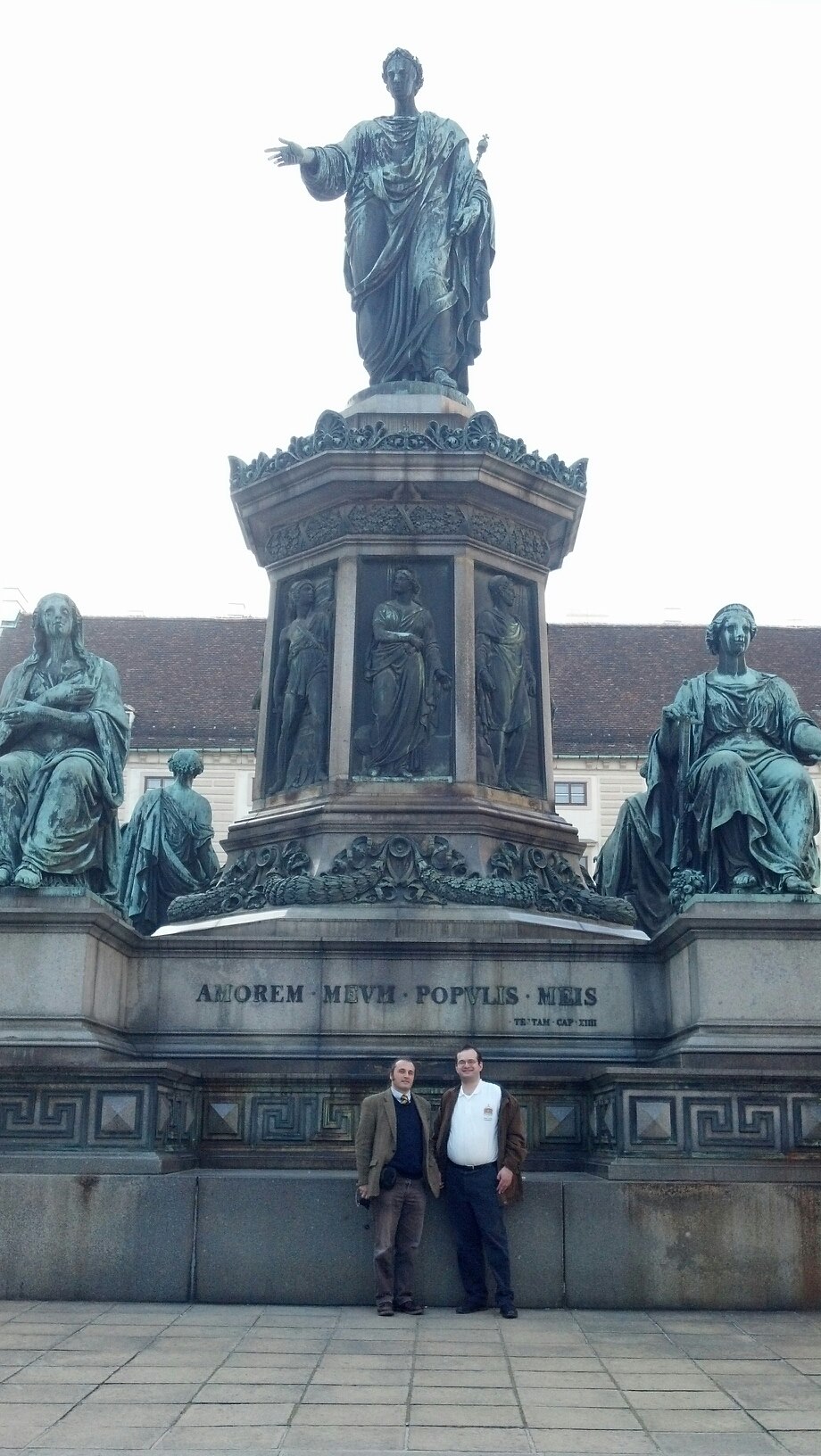
(with Alexander Simec at the statue of Emperor Franz II/I at the Hofburg in Vienna on 16 March)
Monday, January 28, 2013
Beatrix to Abdicate
Queen Beatrix of the Netherlands has just announced in a televised address to the nation that she will abdicate on 30 April, making her reign exactly 33 years. Congratulations Your Majesty on exemplary
service to your country and people. And good luck to the future Willem
IV, who will become the first King of the Netherlands since 1890.


Friday, May 18, 2012
Royalty of the World at Windsor

Front row (L-R): HIM the Emperor of Japan, HM the Queen of the Netherlands, HM the Queen of Denmark, HM the King of the Hellenes, HM the King of Romania, HM the Queen of the United Kingdom, HM the King of Bulgarians, HM the Sultan of Brunei, HM the King of Sweden, HM the King of Swaziland, HSH the Prince of Liechtenstein.
Middle row (L-R): HSH the Prince of Monaco, HRH the Grand Duke of Luxembourg, HM the King of Lesotho, HM the King of the Belgians, HM the King of Norway, HH the Emir of Qatar, HM the King of Jordan, HM the King of Bahrain, HM the Yong di-Pertuan Agong of Malaysia.
Back row (L-R): HH Prince Nasser Mohamed of Kuwait, HH the Crown Prince of Abu Dhabi, HRH the Crown Prince of Yugoslavia, HM the King of Tonga, HRH the Crown Prince of Thailand, HRH Princess Lalla Meryem of Morocco, HRH Prince Mohammed bin Nayaf of Saudi Arabia.
Apparently that April 22 Telegraph article was much ado about nothing, as the former King of the Hellenes attended the Queen's Diamond Jubilee lunch after all, with no earth-shattering consequences, whatever Greek republicans say, resulting in a wonderful unique photograph (perhaps the most comprehensive ever taken) of most of the world's reigning monarchs. Other members of the British royal family including the Duke & Duchess of Cambridge joined the Queen in welcoming this illustrious international assembly of royalty to Windsor Castle. The absence of Queen Sofia and any representative of the royal families of Cambodia, Bhutan, and Oman is to be regretted, though monarchists can rejoice to see not only King Constantine but also the former kings of Romania and Bulgaria and the crown prince of Yugoslavia included. Discussion however has been dominated by the presence of the controversial Kings of Bahrain and Swaziland, though I doubt most British people really mind nearly as much as noisy troublemakers apparently think they should. Once again I say the Queen can invite who she likes; it's not as if democratic republican governments never host controversial republican heads of state!
Tuesday, May 15, 2012
International Royalty to Gather for Jubilee

Friday, February 24, 2012
Prince Friso may not recover
In a very sad development for the Dutch Royal Family, Austrian doctors announced that Prince Johan Friso, 43, in a coma since being buried in an avalanche a week ago, has suffered massive brain damage and may never recover. Please keep Prince Friso, his wife Mabel, their daughters Luana (6) and Zaria (5), his mother Queen Beatrix, his brothers Willem-Alexander and Constantijn, and all the Dutch Royal Family in your thoughts and prayers.


Saturday, February 18, 2012
Dutch Prince Johan Friso in avalanche

Prince Johan Friso, second son of the Queen of the Netherlands, is in critical condition having been buried in an avalanche while skiing in Austria. The prince and his wife Mabel have two young daughters and live in London. I'm sure all readers will join me in wishing him a full recovery during this difficult time for the Dutch Royal Family.
Tuesday, November 8, 2011
The Queen and my Maestro
I was delighted to learn today that HM Queen Beatrix of the Netherlands took the time to personally congratulate Jaap van Zweden, the Dutch music director of the Dallas Symphony in which I am a cellist, on having been named "Conductor of the Year" by Musical America, extending her appreciation to us musicians as well. Congratulations Maestro and Thank You Your Majesty! I look forward to performing with the DSO at the Royal Concertgebouw in Amsterdam in early 2013; who knows, perhaps HM and/or other members of the Dutch Royal Family will attend!
Monday, June 20, 2011
Succession "reform," again...
Hopefully these latest efforts to abolish male primogeniture and repeal the Act of Settlement will prove too complicated and go nowhere. Sometimes I find the "modernisers" almost as annoying as republicans. "Fairness" and "Equality" are not the point of a hereditary monarchy. How is it any more fair to favour the eldest child? Doesn't that "discriminate" against younger siblings? (Not to mention people not born into the royal family, as republicans--who are at least consistent, much as I despise them--will point out.) Is there no one in Government who will point this out and obstruct the nonsensical egalitarian agenda?
Asked by a liberal Dutch monarchist to address the point that to him hereditary succession itself seems more rational than favouring males over females, I responded at my forum that one rational argument is that republicans especially in the Commonwealth countries would do their utmost to turn the necessary debate into one on the very existence of the monarchy itself. Most of us would rather not open that can of worms.
The Kingdom of the Netherlands is relatively new, a creation of the post-Napoleonic era, so it is perhaps somewhat more appropriate for it and its even younger neighbour the Kingdom of Belgium to "move with the times" to a certain extent (though I don't really agree with the adoption of equal primogeniture there either). But the British Monarchy with its roots in the ninth century is all about Tradition, and the tradition there has been for male monarchs to be the norm (even if it doesn't quite seem like it due to three female monarchs having had exceptionally long reigns), with queens regnant the exception. Personally as an admirer of Elizabeth I, Victoria, and Elizabeth II I think that female monarchs shine when they are the exception, having come to the throne due to the absence of any (living) brothers.
I would consider it a travesty for Prince William's eldest son to be bypassed by a sister, which with the unique exception of Prince James Stuart (1688-1766) (hardly analogous to the present situation; somehow I doubt the "Glorious Revolution" was motivated by concern for gender equality) has never happened before in the history of the British monarchy. It is natural, and in accord with most monarchical traditions, for the eldest son of a king to expect to be king in turn, and cruel to deny that to him as it has been denied to Prince Carl Philip of Sweden (b 1979) whose sister Crown Princess Victoria (b 1977) would probably have preferred not to be heir to the throne. [In the Netherlands, ruled by Queens since 1890, it's a moot point at present since Prince Willem-Alexander has three daughters and no sons, but in Belgium Princess Elisabeth (b 2001) precedes her brother Prince Gabriel (b 2003), which still seems odd to me.]
Wednesday, February 16, 2011
The Monitor on Monarchies
The Christian Science Monitor has a decent and thorough (albeit slightly patronizing) article on the world's remaining monarchies. It's nice to see monarchies besides Britain's covered in a prominent English-language publication, though the map omits Bhutan. I'm not always sure if contemporary monarchists should be offended by the label "anachronistic," or embrace it. What do readers think?
Monday, September 20, 2010
"Scandal-Ridden" Monarchies?
Canadian publication Maclean's irreverently profiles Europe's surviving monarchies. Writer Patricia Treble exaggerates the importance of various "scandals" and (as RadicalRoyalist points out) ignores the rather more serious problems plaguing republics such as Germany's, but concludes that monarchies are "good fun" and acknowledges that republics are no cheaper. Serious monarchists, however, are likely to regret that "good fun" is the extent to which modern monarchies are all too often appreciated, and may be forgiven for wondering if the marital decisions of younger royalty might indeed have something to do with it.
Monday, August 23, 2010
Prince Carlos Hugo of Bourbon-Parma (1930-2010)
Prince Carlos Hugo of Bourbon-Parma (b 8 Apr 1930, Paris) died on Wednesday at 80 in Barcelona (Telegraph obituary). He was the head of the branch of the Bourbon family that ruled the Italian state of Parma until 1860 and was a "Carlist" claimant to the Spanish throne. His 1964 marriage to Dutch Princess Irene (they had four children and later divorced), younger sister of Queen Beatrix, was controversial in the Netherlands at the time. The Dutch royal family led mourning this week in The Hague. Some pictures are available at my forum (thanks to "Ethiomonarchist") here and here.
Thursday, May 27, 2010
Modern Monarchy and the Boston Globe
Recently The Boston Globe published an interesting reflection on the place of monarchs in the modern world, Saved by the crown. From violent protests in Thailand to parliamentary politics in Britain and Belgium, the role of the Crown has attracted attention in recent months. If people like Council on Foreign Relations Fellow Joshua Kurlantzick (who doesn't exactly seem like a monarchist but at least understands that contemporary constitutional monarchs can be more than decorations) are taking monarchy seriously, that's an encouraging sign.
It's unfortunate that these days Monarchy is likely to be defended only in terms of what it can do for Democracy and Modernity, but that's probably the best monarchists can expect from a mainstream publication such as the Globe. I do not, of course, agree with all of the article's assumptions, particularly the astonishing claim that "where kings and sultans still actually rule...monarchs can be every bit as oppressive and opaque as any other dictatorship." On the contrary, I think it's a pretty fair generalization that with the possible exception of Saudi Arabia (probably my least favorite current monarchy), throughout the Muslim world it is the monarchies that consistently are and have been the most reasonable regimes, from both non-Muslim and female perspectives, and even Saudi Arabia's current King Abdullah is not without his relatively progressive initiatives, as the article admits.
As far as Europe is concerned, it's worth noting that the arguably problematic "Constitutional Monarchs Help Facilitate Democracy and Multiculturalism" defense is one reason why many right-wingers today have no interest in monarchy. I myself would confess to be less than entirely comfortable with modern European royalty's apparent acquiescence to the massive changes being imposed on their societies via mass immigration, not to mention other troubling developments such as the emasculation and destruction of the House of Lords in Britain. But it's nevertheless a legitimate point that, like it or or not, these situations have been brought about by governments elected by the peoples of those countries, and the royals really have no choice but to make the best of them. Perhaps constitutional monarchy in countries like Sweden and the Netherlands really will be the glue that prevents immigration from having the most dire consequences feared by many on the Right and somehow makes modern Europe work in spite of itself.
If that's the case, people (especially politicians) in former monarchies from Serbia to Laos would do well to pay attention to The Boston Globe. For what this article proves is that one need not be a reactionary alienated from modernity and its democratic values to see the value of kings and queens. On many fronts, pure traditionalists frankly have lost, and reversal seems unlikely. But if the advantages of restoration of monarchy can be appreciated even from a generally modernist perspective, there is no reason to give up on this particular front. Symbols matter, and are worth fighting for, even--or perhaps especially--if they mean different things to different people. So whether you see the Crown as the embodiment of the traditional civilisation you nostalgically prefer to the present, or as an effective tool for addressing the problems of modernity capable of endless reinvention and adaptation, or even some combination of the two, join the fight for the restoration and preservation of monarchies! Even The Boston Globe understands.
Wednesday, September 16, 2009
Prinsjesdag
The Dutch royal family gathered for the glittering opening of Parliament by Queen Beatrix.
Thursday, April 30, 2009
Dutch royal parade car attack
The Dutch royal family expressed their shock and horror after a car apparently aiming for the royal bus crashed into the crowd celebrating Queen's Day, killing several people and injuring more. Dutch police charged the driver with attempting to attack the royal family.
UPDATE (May 1): The driver of the car has died of his injuries.
UPDATE (May 1): The driver of the car has died of his injuries.
Subscribe to:
Posts (Atom)